In total, there have been four major reactor accidents throughout history. Three of them occurred at nuclear power plants, and one took place at the military reactor Windscale.
Accidents at nuclear power plants and incidents involving radioactive sources in general are classified according to the INES scale (The International Nuclear and Radiological Event Scale).
If a release of radioactive substances occurs, it is the authorities in the country where the accident happened that are responsible for classifying the event on the INES scale. The scale is not objective like the Richter scale. This means, for example, that an accident at a nuclear power plant can be upgraded or downgraded on the scale as the authorities in the affected country get a better handle on the extent and consequences. For example, the Fukushima accident in March 2011 began as an INES 3 incident, but was subsequently gradually upgraded to a 4, a 5, and finally a 7. This happened both because the accident evolved, and because it was only little by little that an overview could be formed of how severe it was.
Chernobyl
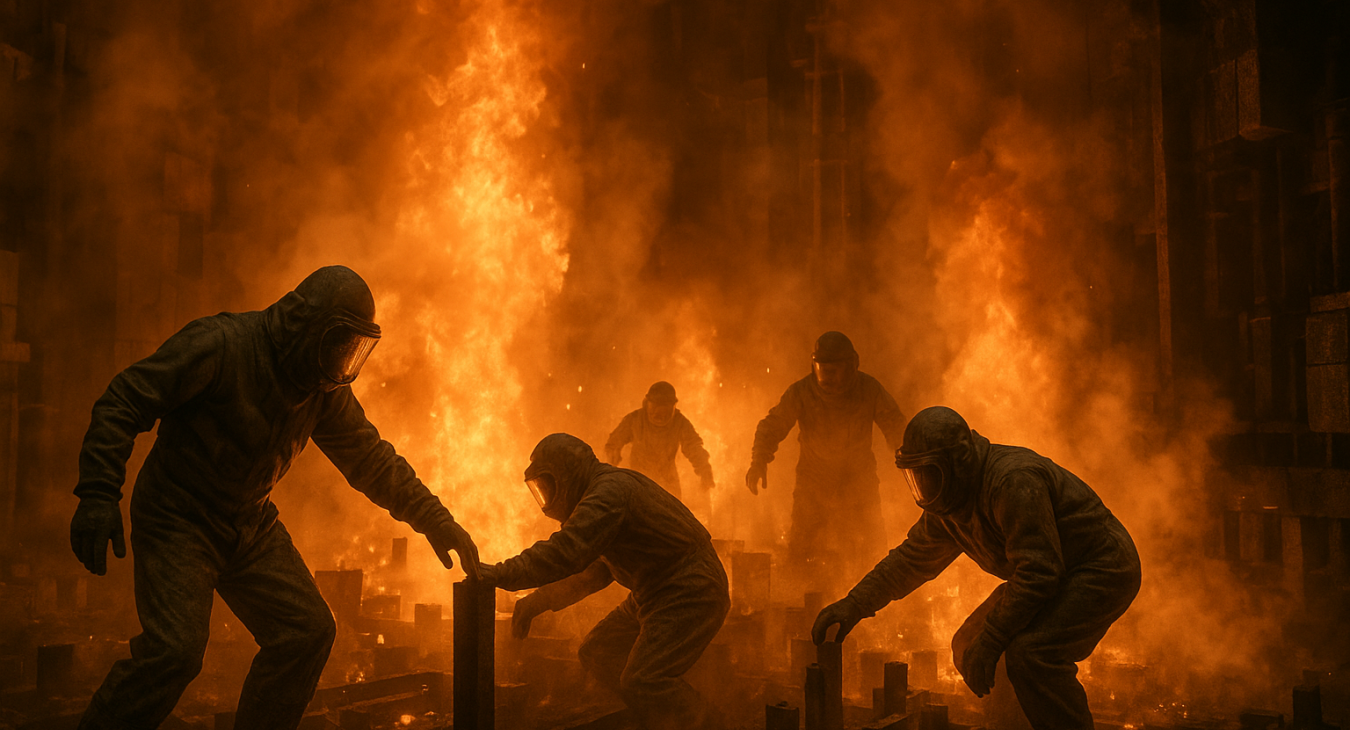
The worst nuclear accident ever occurred in Chernobyl in present-day Ukraine in 1986. On April 26, 1986, the chain reaction in the reactor ran out of control, and a violent steam explosion blew the top off the reactor. This gave oxygen access to the large amounts of very hot, combustible graphite around the fuel rods, and the graphite burned intensely for about 10 days. The intense heat sent the release from the molten core high into the atmosphere, so radioactive particles spread over huge areas.
The accident had serious human and societal consequences. 28 firemen and employees died after being exposed to intense radiation during firefighting. Over 100 others suffered radiation injuries. The then Soviet authorities evacuated about 115,000 people from the area around the plant, and in the years after 1986, 220,000 people from Belarus, Russia and Ukraine had to relocate to areas with less radiation. Up to 2005, 6,000 cases of thyroid cancer among children and adolescents have been registered in the three countries, and most of them are believed to be due to radiation from the accident. Apart from this increase, no major health consequences from the radiation have been detected (source: United Nations Scientific Committee on the Effects of Atomic Radiation, UNSCEAR).
The approximately 134 firemen and employees who fought the fire in Chernobyl in 1986 received extremely high radiation doses between 700 and 13,400 mSv. 28 of them died from the radiation injuries. (source: Unscear 2008 report vol. II, unscear.gov)
Fukushima
On March 11, 2011, a massive earthquake measuring 9.0 on the Richter scale struck Japan. The quake occurred in the sea northeast of Fukushima. The three reactors operating at the Fukushima Daiichi plant shut down automatically as planned. But the quake generated a tsunami that flooded the plant and knocked out the emergency power systems, stopping the cooling of the reactor cores. This led to the fuel in the reactors partially melting, and large amounts of hydrogen formed, which exploded in the top of two of the reactor buildings. At the same time, large quantities of radioactive substances were released into the atmosphere, and thousands of people were evacuated from the area around the plant.
There were no direct deaths due to radiation, but a higher mortality has been observed among the evacuees. The plant can no longer be used and must be decommissioned, something that is expected to take at least 30 years. Additionally, the contaminated areas must be cleaned up. (IAEA and WHO)
Three Mile Island
The accident at the Three Mile Island plant near Harrisburg, Pennsylvania, USA, occurred on March 28, 1979 and was due to a combination of design flaws, component failures and especially human errors. This meant that the core was not sufficiently cooled and therefore partially melted. The operators eventually reestablished cooling and halted the melting. About half of the core melted, but everything remained inside the reactor vessel. The containment building was intact, so the radioactive substances were retained – apart from a small release of radioactive gas which had no health consequences for the population.
The reactor accident has been classified on the INES scale as a level 5 incident due to the significant damage to the core.
Windscale
On October 10, 1957, a fire broke out in one of the Windscale reactors, and radioactive material was released into the atmosphere. The Windscale reactors were designed to produce nuclear weapons and had no containment. However, compared to the releases from Chernobyl and Fukushima, it was small, which is reflected in the fact that the accident is classified as INES 5, while the other two are at level 7, the highest. No one in the area was evacuated, but milk from cows in an area of about 500 km² had to be discarded for a month, because the fallout contained radioactive iodine that could otherwise be absorbed into the thyroid gland through the milk.
About the INES scale
- The INES scale was launched in 1990 to make it easy to inform the public and press about how serious a radioactive release is.
- The scale is logarithmic, like the Richter scale for earthquakes. That means the severity of an incident increases tenfold for each step.
Categories
The INES scale has seven levels.
- Levels 1-3 are called incidents.
- Levels 4-7 are called accidents.