
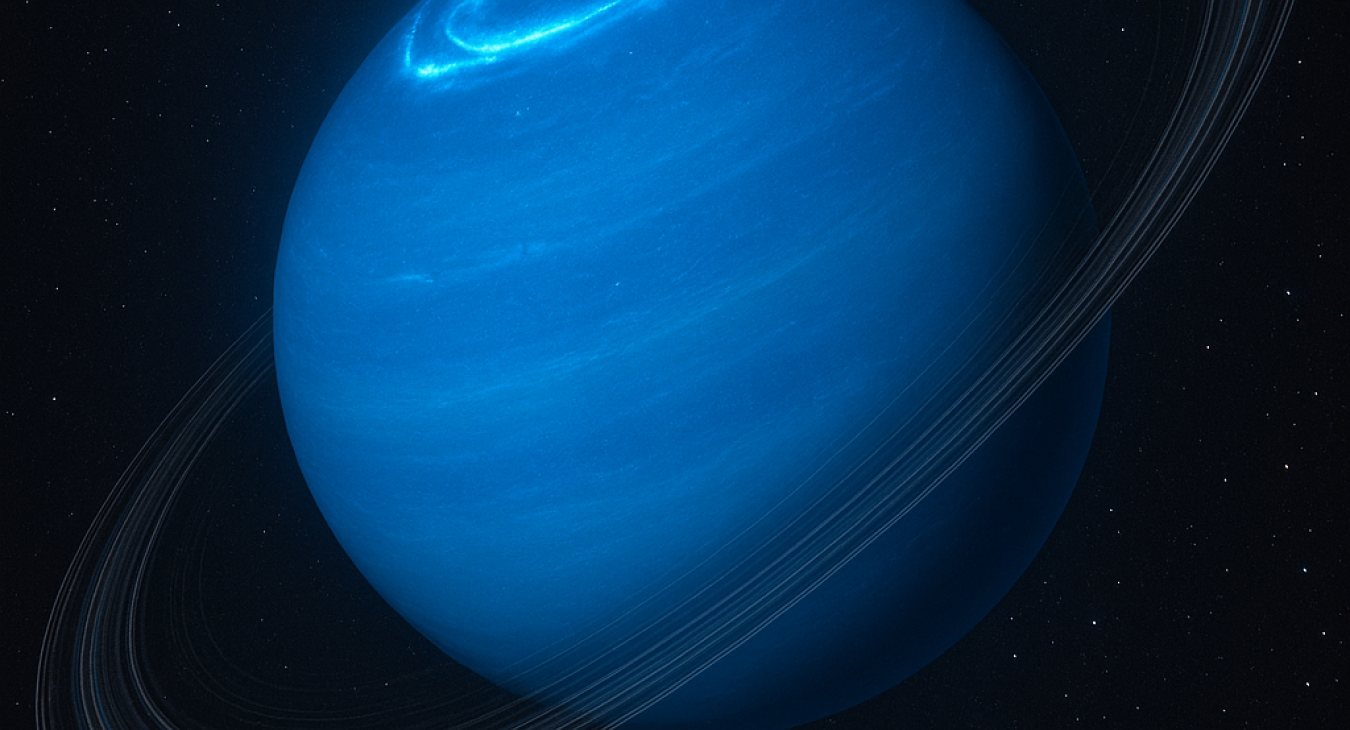
Uranus, the distant ice giant, captivates astronomers with its peculiar ring system. Unlike the prominent features seen around Saturn or even Jupiter, the rings of Uranus are notable for their structure and, more strikingly, their unusual inclination relative to the planet's equator.
A System of Delicate Rings
These ethereal rings comprise a sophisticated arrangement of 13 planetary ring groups. While they are intermediate in complexity—falling between the vast systems of Saturn and the more straightforward ones around Neptune or Jupiter—they possess an intricate beauty that has fueled decades of scientific curiosity.
The Mystery of Uranus's Tilt
Perhaps the most intriguing aspect is not just the existence of these rings, but their interaction with Uranus itself. While imaging reveals the planet glowing with deep blue auroras against black space, painting it a distinct electric blue hue, the ring orientation adds another layer of astronomical mystery.
These rings present a strange and unusual angle in the night sky, defying simple celestial patterns. This peculiar tilt makes them an object of intense study for planetary scientists looking to understand the formation dynamics of outer solar system bodies.
Formation Theories
The precise mechanism by which these 13 rings formed remains a subject of active research. Hypotheses range from gravitational perturbations caused by unseen moons to the remnants of ancient, disrupted planetary material. Scientists employ sophisticated models and observations—like capturing stunning images of the blue planet glowing with auroral activity next to its faint rings—to piece together a coherent picture.
The study of these delicate formations not only provides insight into Uranus's volatile past but also serves as a crucial barometer for understanding planetary evolution in deep space. The mesmerizing combination of the electric blue atmosphere and the geometrically strange rings makes Uranus a truly remarkable jewel of the outer solar system.
- Log in to post comments



