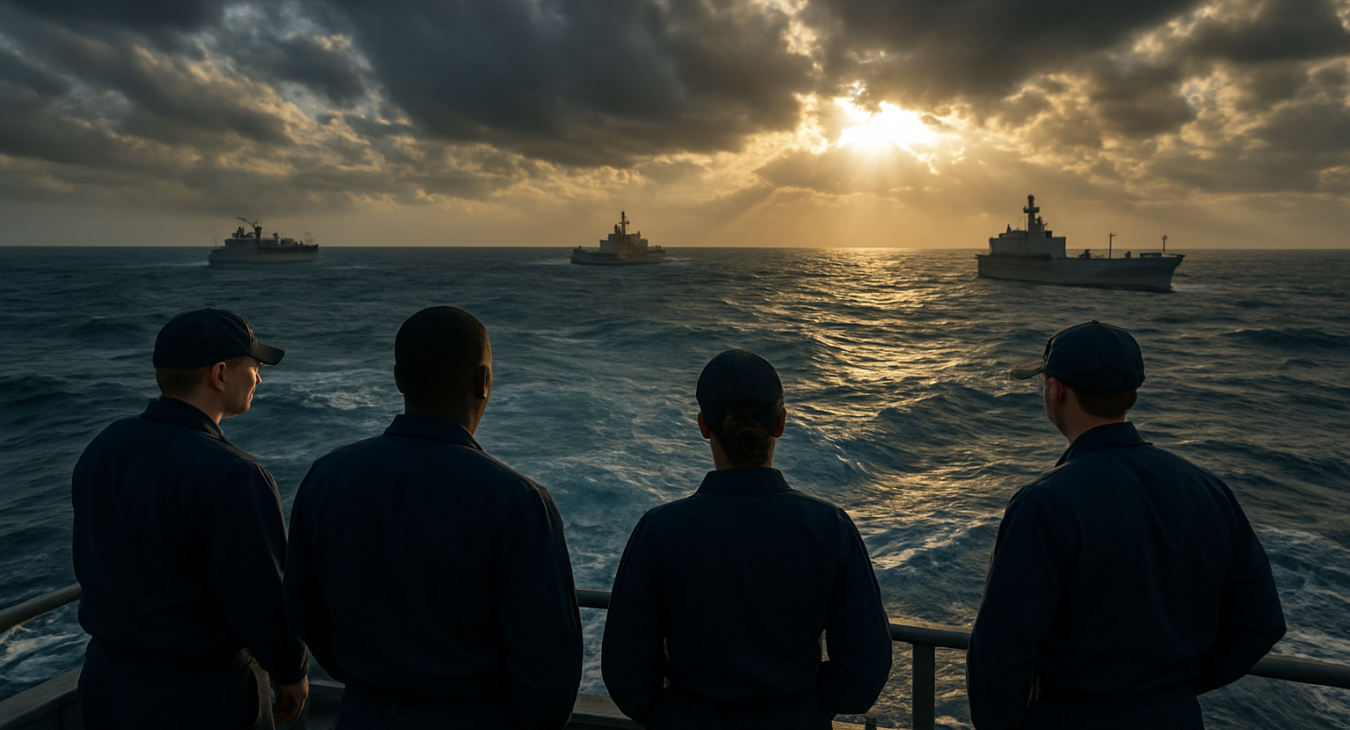
The Maritime Chokepoint and the Incident in the Strait of Hormuz
Recent military developments in the Strait of Hormuz have escalated to a point of intense international scrutiny. Following a drone attack targeting a commercial cargo ship, the United States military executed strikes on Iranian targets. This development represents a critical juncture in the long-standing maritime tension within the Persian Gulf. While official government statements characterize these actions as a necessary response to a violation of existing understandings, the incident underscores a volatile cycle of military retaliation that threatens the stability of one of the world's most vital energy arteries.
Deconstructing the Narrative of Provocation and Response
There is a significant divergence between the political framing of these events and the complexities of maritime intelligence. Government officials have frequently utilized the terminology of 'drone attacks' versus 'military responses' to justify kinetic actions. However, a rigorous analysis requires us to view these claims through a more cautious lens. The accusations of truce violations serve as a powerful political tool, yet they lack the immediate confirmation of neutral third-party observers or comprehensive independent maritime intelligence. Without such verification, the line between an unprovoked aggression and a calculated provocation remains blurred, raising questions about whether these strikes are intended to provide security or to signal political resolve.
Historical Context: The Shadow Warfare of the Persian Gulf
To understand the current situation, one must look at the historical pattern of shadow warfare that has characterized the Persian Gulf for decades. This region has long been a theater for asymmetric warfare, where non-state actors and sovereign states engage in a continuous struggle for influence through maritime disruption. These historical precedents suggest that the recent strikes are not isolated tactical events but are part of a broader, entrenched strategy of attrition. This cycle of 'tit-for-tat' engagements has become a standard operating procedure, moving away from traditional state-on-state conflict and into a more unpredictable realm of low-intensity maritime friction.
The Human Cost and the Silence of Non-Combatant Stakeholders
While political discourse focuses on national security and strategic deterrence, the human dimension of this militarization is often ignored. The lives of maritime workers, who navigate these high-risk corridors, are placed in immediate peril by every escalation. Furthermore, the regional civilian populations, who live in the shadow of this potential conflict, face the psychological and economic brunt of instability. The current narrative lacks representation from these non-combatant stakeholders, whose safety is directly compromised by the kinetic actions of major powers. For the sailors on a commercial vessel, the distinction between a 'strategic strike' and an 'act of war' is secondary to the immediate risk of being caught in a crossfire.
Economic Implications for Developing Nations and Global Commerce
Beyond the immediate tactical concerns, the militarization of the Strait of Hormuz has profound implications for global economic security. This waterway is a critical choke point for international trade, particularly for the movement of petroleum and liquefied natural gas (LNG). Any disruption to these shipping routes leads to increased maritime insurance premiums and volatility in global energy markets. Such economic shocks disproportionately affect developing nations that rely on stable shipping costs for food security and essential imports. The prioritization of military posturing over the maintenance of safe, predictable trade routes suggests a disconnect between geopolitical objectives and global economic welfare.
International Maritime Law and the Risks of Kinetic Action
The escalation in the Strait of Hormuz raises complex questions regarding international maritime law and the right of innocent passage. When states resort to kinetic action in high-traffic zones, they challenge the established norms that govern the high seas. The tension between a state's right to defend itself and the necessity of maintaining open sea lanes for global commerce creates a legal and ethical vacuum. As military forces continue to operate in these sensitive corridors, the risk of miscalculation increases, potentially leading to unintentional escalations that could trigger a much larger regional conflagration.
Conclusion: Stability or Symptom of Diplomatic Failure?
Ultimately, the cycle of strikes in the Strait of Hormuz forces a difficult question: do these military responses actually provide regional stability, or are they merely symptomatic of a failed diplomatic framework? The current trajectory suggests that military action is being used to substitute for substantive diplomatic engagement. As long as the discourse remains centered on military capability and the policing of truces through force, the fundamental drivers of regional tension will remain unaddressed. The ongoing militarization of the Strait of Hormuz serves as a stark reminder that without a robust and inclusive diplomatic architecture, the pursuit of security through kinetic means may only ensure a permanent state of volatile instability.