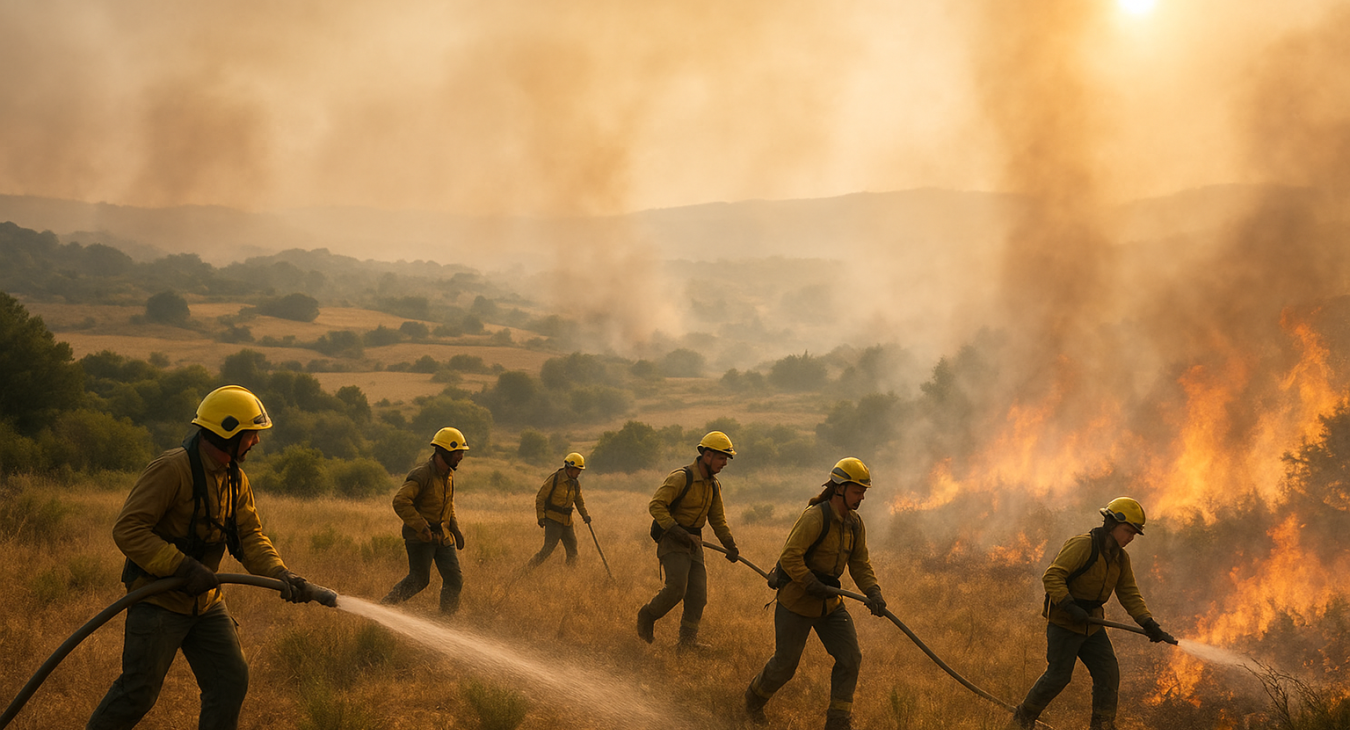
Understanding the Rise of Fire Whirlwinds in France and Their Broader Environmental Implications
Introduction to the Escalating Fire Landscape in France
In recent years, the landscapes of southern France have become a testing ground for the most violent expressions of wildfire behavior. Among these, fire whirlwinds, often referred to scientifically as fire tornados or fire devils, have emerged as a significant threat. These phenomena occur when intense heat from a wildfire creates powerful convective currents that begin to rotate due to wind shear or topography, creating a spinning vortex of flame and debris. While the role of anthropogenic climate change is a primary driver in the increased frequency of extreme fire weather, the phenomenon in France cannot be understood through atmospheric science alone. It requires a deep dive into the intersection of meteorology, historical land management, and the changing socio-economic structures of the Mediterranean basin.The Meteorology of Fire Whirlwinds and the Fire Weather Paradox
Scientific research indicates that anthropogenic climate change is responsible for nearly half of the long-term increases in fire weather and drought conditions within the Mediterranean region. This shift has increased the likelihood of rare fire weather conditions by an estimated 88 to 152 percent. When high temperatures, low humidity, and strong winds converge, the Fire Weather Index (FWI) reaches extreme levels, providing the necessary energy for fire whirlwinds to form. However, a paradox exists where atmospheric models, while accurate in predicting heatwaves, may overlook the local drivers of fire behavior. The atmospheric conditions provide the fuel for the fire, but the physical state of the landscape determines whether that fire evolves into a standard blaze or a localized, spinning vortex of intense heat.Landscape Management and the Role of Rural Depopulation
To understand why fire whirlwinds are becoming more intense, one must examine the 'fire weather' paradox through the lens of land use. For centuries, the Mediterranean landscape of France was maintained through active human agency, primarily through traditional grazing practices and small-scale agricultural management. These practices acted as natural fuel breaks, reducing the continuity of combustible materials. In recent decades, rural depopulation and the abandonment of traditional pastoralism have led to significant forest fragmentation and the accumulation of dense, continuous fuel loads. As forests reclaim abandoned agricultural land, they create a massive, uninterrupted reservoir of biomass. This increased fuel continuity allows a fire to grow large enough to generate the intense convective columns required to produce fire whirlwinds.Critiquing Deterministic Models and the Risk of Complacency
While global climate models are essential for long-term planning, a purely deterministic approach that focuses solely on rising temperatures may inadvertently encourage political complacency. If the rise of extreme fire phenomena is framed as an inevitable consequence of global warming, there is a risk that local governments and citizens may view these events as unavoidable natural disasters rather than manageable risks. This perspective can lead to a lack of investment in localized mitigation strategies. Instead of viewing fire whirlwinds as a destiny, it is crucial to recognize the human agency involved in creating the fuel loads that permit these phenomena to escalate from surface fires to extreme convective events.The Scaling of Mitigation: Prescribed Burns and Forest Thinning
Current wildfire mitigation strategies, such as prescribed burns and forest thinning, are vital tools in reducing fuel loads. However, there is an urgent question regarding whether these strategies are being scaled sufficiently to meet the shifting reality of French fire dynamics. Prescribed burns, which involve the controlled application of fire to reduce undergrowth, require precise meteorological windows to be safe and effective. As fire seasons lengthen and become more unpredictable, these windows are narrowing. If forest management cannot keep pace with the rapid accumulation of biomass caused by land abandonment, the effectiveness of these mitigation efforts may diminish, leaving communities vulnerable to the unpredictable paths of fire whirlwinds.Historical Context: Natural Cycles versus Unprecedented Shifts
It is important to distinguish between the historical fire regimes of Mediterranean ecosystems and the modern phenomena being observed in France. Mediterranean climates have always been fire-adapted, with cyclical natural variations causing periodic blazes that facilitate certain ecological processes. However, the current shift is unprecedented. The intensity and frequency of the recent fire events in southern France suggest a departure from these historical patterns. The rise of fire whirlwinds signifies a transition from traditional fire regimes to a new era of extreme fire behavior, where the scale of the energy released exceeds the historical norm for these ecosystems.The Human Dimension: Socio-Economic and Ecological Consequences
The impact of fire whirlwinds extends far beyond the immediate destruction of timber. These extreme events have profound socio-economic implications, particularly regarding insurance accessibility in Mediterranean regions. As the risk profile of certain areas increases, insurance premiums may rise or coverage may become unavailable, threatening the economic stability of rural communities. Furthermore, the intense heat and unpredictable movement of fire whirlwinds can disrupt biodiversity migration patterns, destroying complex habitats more rapidly than species can adapt. The unpredictable nature of these vortices makes them particularly dangerous for local economies that rely on tourism and agriculture, as the localized destruction can be catastrophic and difficult to predict.Conclusion: Integrating Science and Policy for Resilience
Addressing the threat of fire whirlwinds in France requires an integrated approach that bridges atmospheric science with sociology and land-use policy. We must move beyond the narrative of inevitability and focus on building tangible community resilience. This includes investing in infrastructure that can withstand extreme heat, scaling up proactive forest management, and supporting rural populations to maintain active land stewardship. By understanding the complex interplay between a warming atmosphere and a changing human landscape, France can better prepare for a future where fire behavior is increasingly extreme and unpredictable.Summary of Key Environmental Drivers
In conclusion, the rise of fire whirlwinds is a multi-faceted phenomenon. On one hand, anthropogenic climate change provides the atmospheric energy by increasing the probability of extreme fire weather. On the other hand, the abandonment of traditional land management creates the physical conditions—specifically, high fuel continuity—that allow these fires to become vortex-forming events. A successful response to this crisis requires a recognition that while we cannot control the global temperature in the short term, we can manage the local landscapes that determine the severity of the flames.Read more articles
Newer
Older