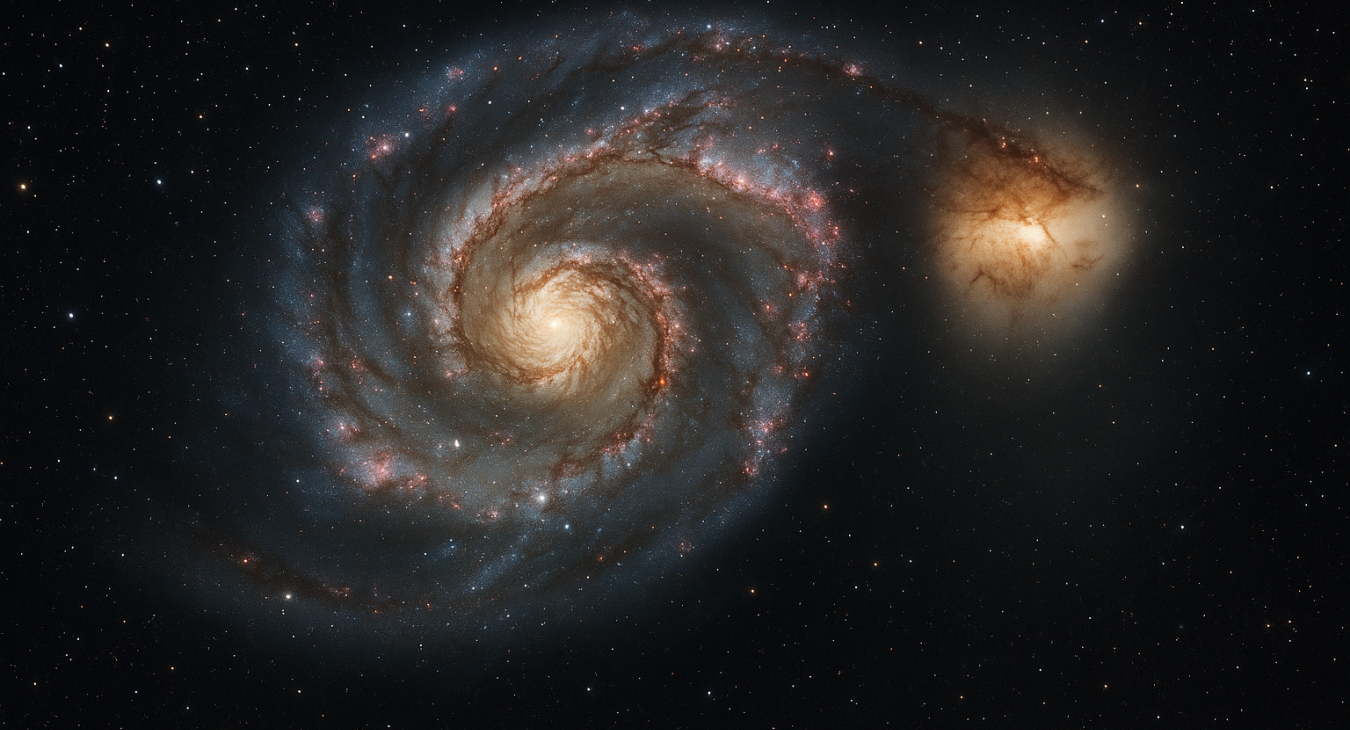
Have you ever looked up at the night sky and felt completely overwhelmed by its breathtaking immensity? The Whirlpool Galaxy, scientifically known as Messier 51 (M51) or NGC 5194, offers one of the most spectacular cosmic shows. This magnificent grand-design spiral galaxy is a true masterpiece, serving not only as a visual wonder but also as a lively laboratory for stellar evolution.
Its historical importance cannot be overstated. Discovered by Charles Messier back in 1773, M51 became a beacon of astronomical study. Even before modern telescopes, its distinct spiral form captured the imagination of early observers, solidifying its place among the most photographed and studied galaxies in our celestial neighborhood.
The Anatomy of a Spiral Masterpiece
M51 is renowned for its stunning, gracefully winding arms. These aren't just beautiful streaks of light; they are complex structures composed of long lanes of stars and gas, laced with cosmic dust. The galaxy is particularly nicknamed the 'Whirlpool' because of its spectacular, sweeping spiral structure, which appears almost like a giant spiral staircase traversing through space.
The visible beauty of these arms hides crucial astronomical functions. These spiral arms act as vital star-formation factories. They compress hydrogen gas within the dust lanes, triggering the creation of massive clusters of brand new stars. This ongoing process gives M51 its dynamic and colorful appearance. Furthermore, the Hubble Space Telescope captured images showcasing this grand design—from the vibrant young stars in the arms to the yellowish core housing older stellar populations.
Cosmic Neighbors and Observable Wonders
One of the joys of observing M51 is its companion. The galaxy interacts with a smaller celestial object, NGC 5195. These two paired galaxies are notably prominent and can actually be observed by amateur astronomers, sometimes even visible with standard binoculars, making them an accessible cosmic adventure.
M51 resides in the constellation Canes Venatici, located near the recognizable handle of the Big Dipper (Ursa Major). Though it is situated approximately 25 to 30 million light-years away, its sheer brilliance makes it a captivating sight. The professional study of M51 and its companion pair provides invaluable data regarding galactic interactions and stellar dynamics.
Understanding the Supernova Chronicle
While the primary focus is on the magnificent spiral structure, every galaxy like M51 is constantly engaged in cosmic cycles of creation and spectacular death. The formation of new stars, as seen in its arms, inevitably leads to the eventual demise of massive stars—a process that often culminates in a supernova. These explosive events are not just dramatic flares; they are essential components of galactic life, enriching the interstellar medium with heavy elements necessary for future generations of life.
Exploring M51 allows us to peer into a grand narrative: the continuous cycle of star birth within the dusty arms and the eventual cataclysmic death that fuels the galaxy's ongoing evolution. Witnessing this cosmic scale reminds us how dynamic and extraordinary the universe truly is, filling our personal stories with astronomical scope.
Read more articles
- Log in to post comments