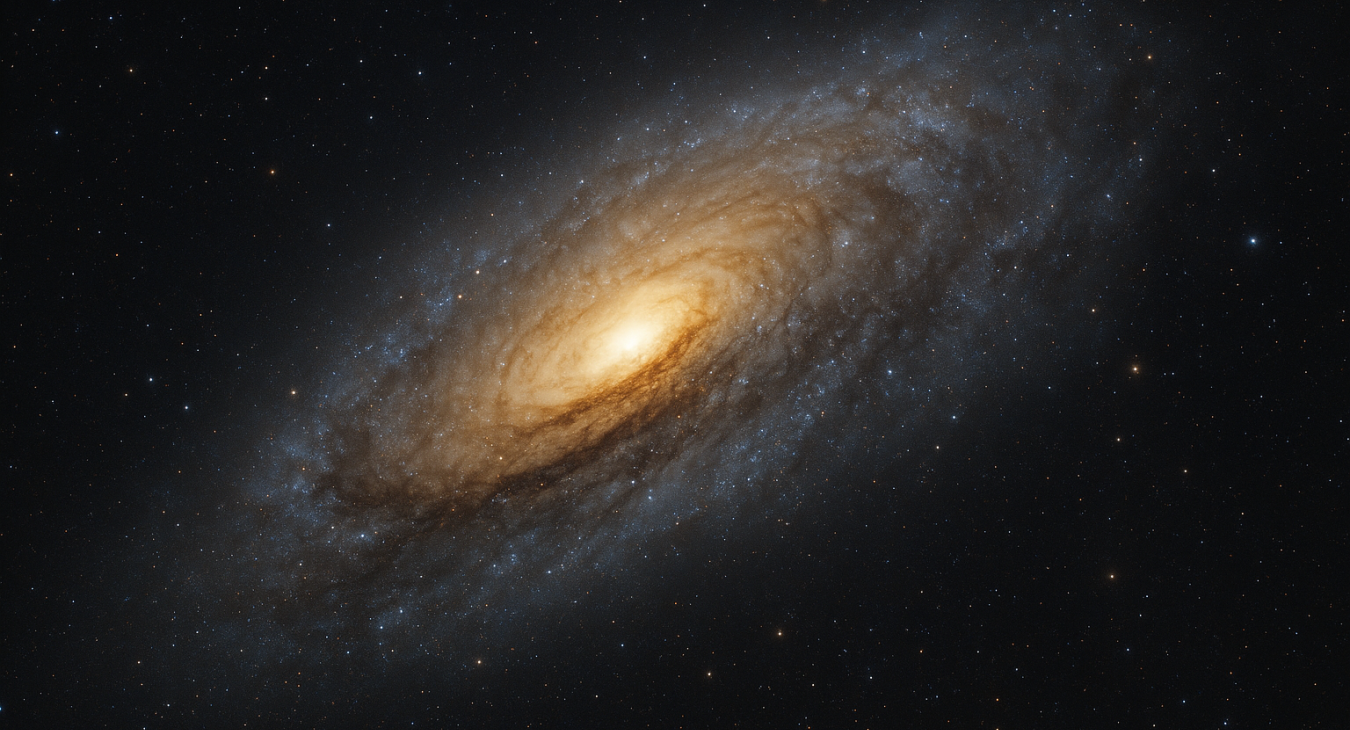
The celestial spectacle known as Messier 64, or M64, is famous for its striking appearance: a dark dust lane that slices across the glowing heart of a spiral galaxy in Coma Berenices. This distinctive feature earned it the evocative nicknames 'Black Eye' and 'Evil Eye' Galaxy.
A Picture of Cosmic History
When scientists examine M64, they are looking at a cosmic record. The light we see from this galaxy traveled for an immense period—17 million years—to reach us, allowing us to witness its past state.
The spectacular dark dust band is not merely cosmetic; it is evidence of profound galactic activity. This dusty system tells a story of violent encounters and transformative change. Astronomers believe that M64's current unusual dynamics are the scars left behind by previous major events, likely involving mergers with other satellite galaxies over billions of years.
Unusual Dynamics and Stellar Birth
One of the most fascinating characteristics of the Black Eye Galaxy is its bizarre internal motion. Unlike typical spirals where gas and stars rotate uniformly, M64 displays regions that are rotating in opposite directions from others within the same galaxy.
This opposing rotation suggests a dramatic merger event occurred long ago. When these oppositely moving gases collide, they compress one another, creating ideal conditions for new stellar formation. These collisions are actively nurturing star birth in specific areas of the spiral.
Observational Insights and Discovery
Historically, this galaxy has been a point of interest since its initial cataloging. Edward Pigott discovered it around 1779, adding it to notable lists like Charles Messier's in 1780.
Modern technology has allowed us to examine M64 with unprecedented detail. Combining observations from powerful telescopes such as the James Webb Space Telescope and the Hubble Space Telescope provides a remarkably clear portrait of this system. These combined views expose rare phenomena, providing confirmation of its turbulent past.
While there isn't an address for this celestial wonder, detailed information regarding astronomical viewing and scientific findings can often be found on major space agency websites. For reliable data and stunning images, resources from NASA are invaluable guides to cosmic mysteries like M64.
A Journey of Wonder
Observing M64 provides a natural sense of awe, reminding us that even objects billions of light years away carry visible signs of monumental events. It is a prime example of how cosmic collisions can drive structure and life within the vast expanse of space.
Read more articles
- Log in to post comments