
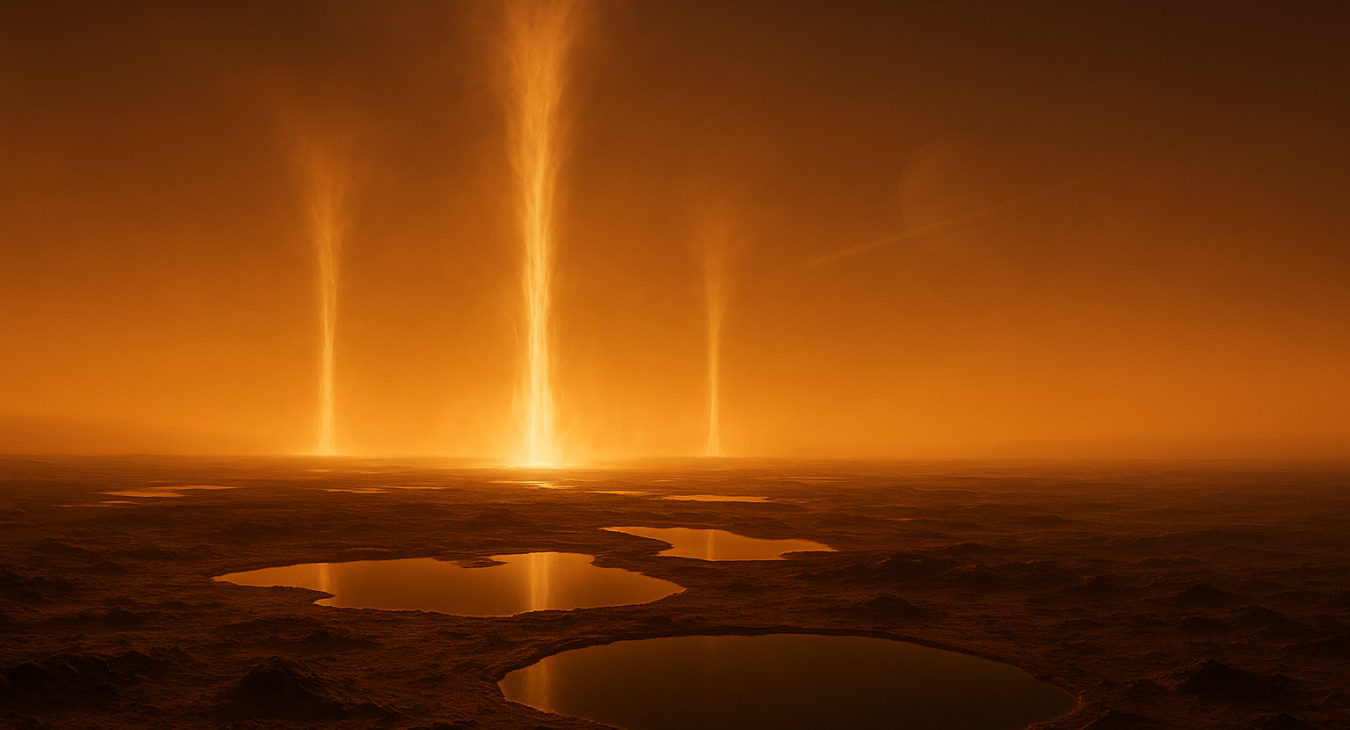
Thinking about the sheer scale of our solar system can be overwhelming, but when we look at Saturn's massive moon, Titan, we find a place that is truly breathtaking. As the second-largest satellite in the Solar System—only surpassed by Ganymede—Titan offers a cosmic landscape unlike any other, making it a captivating subject for dreamers and scientific explorers alike.
What makes Titan so fascinating is not just its immense size, or its dense atmosphere, which is thicker than Earth's; it’s the evidence of dynamic atmospheric processes. While often discussed for its lakes and rivers of liquid methane and ethane—a cycle mirroring Earth's own water cycle but with alien liquids—the potential for significant plumes introduces another layer of mystery.
A Second Nature Cycle
Titan is remarkable because it hosts evidence of complex chemical cycles. On our planet, we understand the familiar loop of evaporation, condensation, and return to surface liquid. Titan exhibits a similar cycle, but instead of water vapor, this process involves liquid hydrocarbons like methane and ethane. This ongoing geological and atmospheric activity keeps its environment constantly evolving.
The Source of the Mystery Vapors
While much attention focuses on the hydrocarbon liquids coating its surface, other observations highlight powerful plumes in the upper atmosphere. For example, recent scientific insights have pointed to massive water vapor structures emanating from distant planetary bodies, demonstrating that such energetic plumes are a significant feature when exploring moons within Saturn's system.
Imagine witnessing an event like a colossal plume stretching for thousands of kilometers—a scale so vast it can span the distance between countries on Earth. Such observations remind us that even remote parts of our solar system maintain breathtakingly dynamic processes, fueled by internal heat and tidal forces.
Connecting to Exploration
These incredible plumes reinforce Titan's status as one of the most chemically active worlds known. Though detailed real-time observational data specifically confirming giant water vapor plumes originating *only* from Titan, are continuously updated by advanced missions like JWST, the principle remains: these icy behemoths are constantly interacting with their atmospheres.
These cosmic wonders inspire us to keep looking skyward. They fuel a profound sense of optimism regarding our place in science and exploration, reminding us that curiosity can literally connect Earth back to distant moons like Titan. It inspires personal stories of awe—of students learning about Jupiter's Ganymede alongside Titan, or astronomers tracking the plumes visible from Saturn’s orbital plane.
The journey of understanding these atmospheric processes is a continuous one, encouraging generations of scientists to follow in the footsteps of pioneers and share their discoveries with the world. It’s an enduring adventure that promises knowledge about the fundamental laws governing all worlds, whether they are covered in liquid ethane or brilliant water vapor.
- Log in to post comments



