  • Dansk
  • English
Home
Thinkiverse
Where every subject connects
  • Front Page
  • Subjects
    • Latest News
  • FAQ
  • Contact
  • Search

Breadcrumb

  1. Home
  2. Latest news

Mercury's Extreme Temperature Swings

Science
Astronomy
Technology
June 16, 2026
by Editor
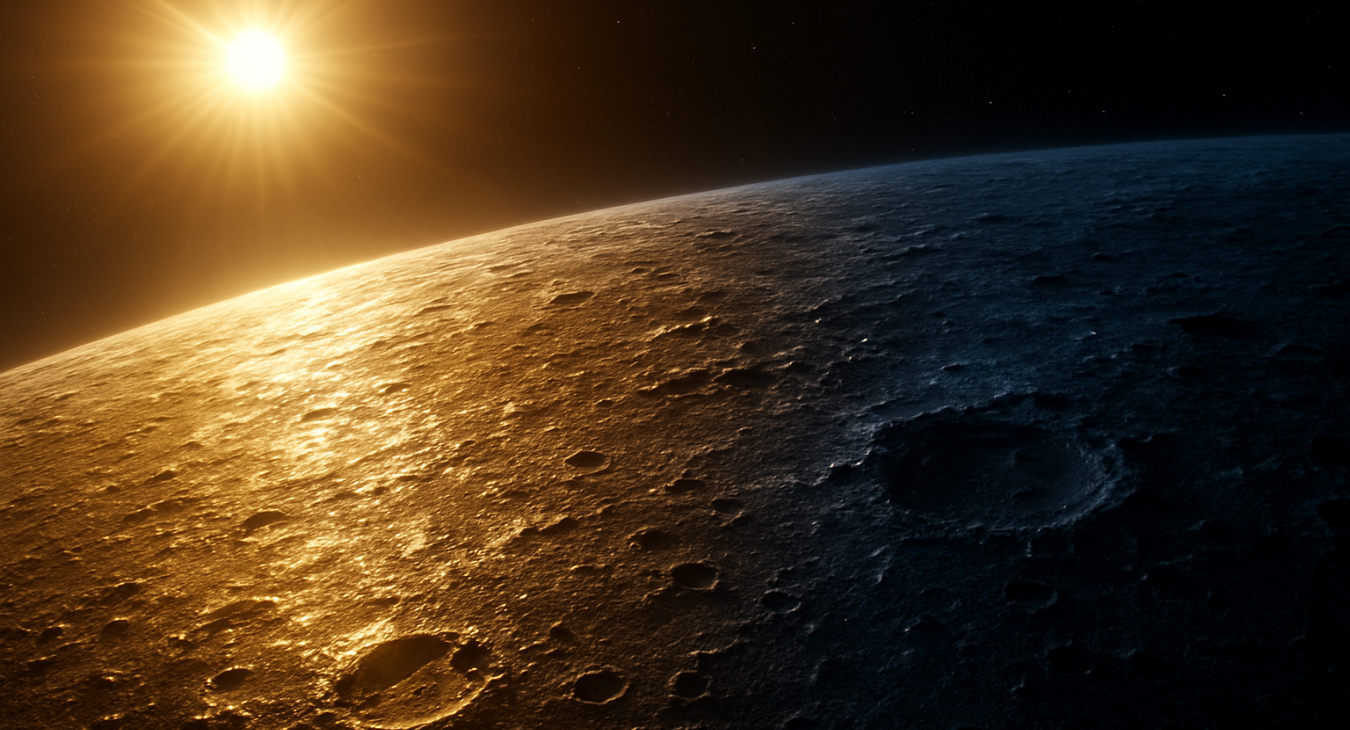
Photorealistic Mercury surface showing the terminator line: one side in scorching sunlight with reflective liquid metal suggesting extreme heat, the other side in dark shadow plunging into deep cryogenic cold.
From Scorching Heat to Freezing Cold

Imagine a world of brutal contrasts, where the scorching heat of day meets the bone-chilling cold of night. This is the dramatic reality of Mercury, the smallest planet and the closest orbiting body to our Sun. Its surface undergoes some of the most extreme temperature fluctuations in the entire solar system.

The Science Behind the Extremes

Mercury's incredible thermal range is not a mystery; it is primarily due to its lack of a substantial atmosphere. Unlike Earth, which has thick atmospheric layers that trap heat and stabilize temperatures, Mercury's thin atmosphere (composed mainly of oxygen and sodium) cannot effectively retain heat.

This means the planet rapidly absorbs and radiates solar energy without significant moderation. When the Sun strikes the surface, temperatures soar to a searing 427°C (800°F). This intensity is so great that it possesses the capability to liquefy metals like tin and lead. Conversely, when night falls, the heat dissipates into space, causing the temperature to plummet dramatically to a frigid -180°C (-290°F).

A Personal Perspective on Planetary Contrasts

While we can only study Mercury from afar, understanding these extreme differentials—from blistering hot to freezing cold—offers a remarkable lesson in planetary dynamics. It highlights how vital even a thin blanket of atmosphere can be for creating stable conditions suitable for exploration.

The Impact of Orbital Proximity

Mercury's close orbit, especially at its closest point called perihelion, places it only about 46 million km from the Sun. This extreme proximity is the root cause of the intensity of solar radiation bombarding its surface. This unrelenting exposure guarantees that the temperature differential remains vast and powerful.

A World of Scientific Fascination

Mercury remains a fascinating study in planetary science, showcasing how fundamental conditions like atmospheric retention determine climatic stability. It is a rocky world with a thin crust overlying an iron-rich core. Observing these temperature cycles allows scientists to better understand the forces that shape worlds, revealing profound differences from Earth.

The sheer scale of this fluctuation—from 800°F down to -290°F—makes Mercury not only inhospitable but scientifically compelling. It is a planet defined by its constant, drastic changes!

How do oxygen and sodium affect Mercury's thermal retention?
How do Mercury's iron content and core conduct heat?

Read more articles

The Mythical Diamond Rain on Uranus and Neptune: A Cosmic Marvel
Newer
The Mythical Diamond Rain on Uranus and Neptune: A Cosmic Marvel
The Mysterious Rings of Chariklo
Older
The Mysterious Rings of Chariklo
  • Log in to post comments
Editor

Related Subjects

The Convergence of Nature and Innovation
Connecting the Dots
AI, Free Will, and the Meaninglessness of Punishment in Machines
Combatting Bats Wisely
Understanding Bat Removal
Effective Bat Control
The Truth About Bat Removal
Debunking Myths
Why Bats Aren't a Nuisance
Effective Bat Control and Removal
  • Thinkiverse: Where Knowledge Intersects

    The Convergence of Nature and Innovation

    Jul 31, 2026
    Chief Editor
  • Thinkiverse: Where Knowledge Intersects

    Connecting the Dots

    Jul 31, 2026
    Chief Editor
  • Free will or deterministic paths

    AI, Free Will, and the Meaninglessness of Punishment in Machines

    Jul 31, 2026
    Editor
  • A diverse group of scientists in field gear using headlamps and binoculars to observe fruit bats in a lush, nocturnal tropical forest.

    Combatting Bats Wisely

    Jul 29, 2026
    Editor
Home
Thinkiverse
Where every subject connects

An overview of the frequently asked questions we try to answer on thinkiverse.dk

How does excluding radical opposition impact political agreements?

How to mitigate the skepticism tax on authentic eyewitness footage?

How will AI investment affect VC for non-AI startups?

How does status-seeking travel impact psychology vs social comparison?

Can 'move fast and break things' be adapted into Japanese corporate culture?

Popular Categories

Science
Technology
Psychology
Health
Politics
Artificial Intelligence
Security
Finance
Environment
Biology
Information Technology
Law
 
Copyright ©, thinkiverse.dk 2026

What is Thinkiverse.dk?

Terms of usage