
Magellanic Clouds: Neighbors in Orbit
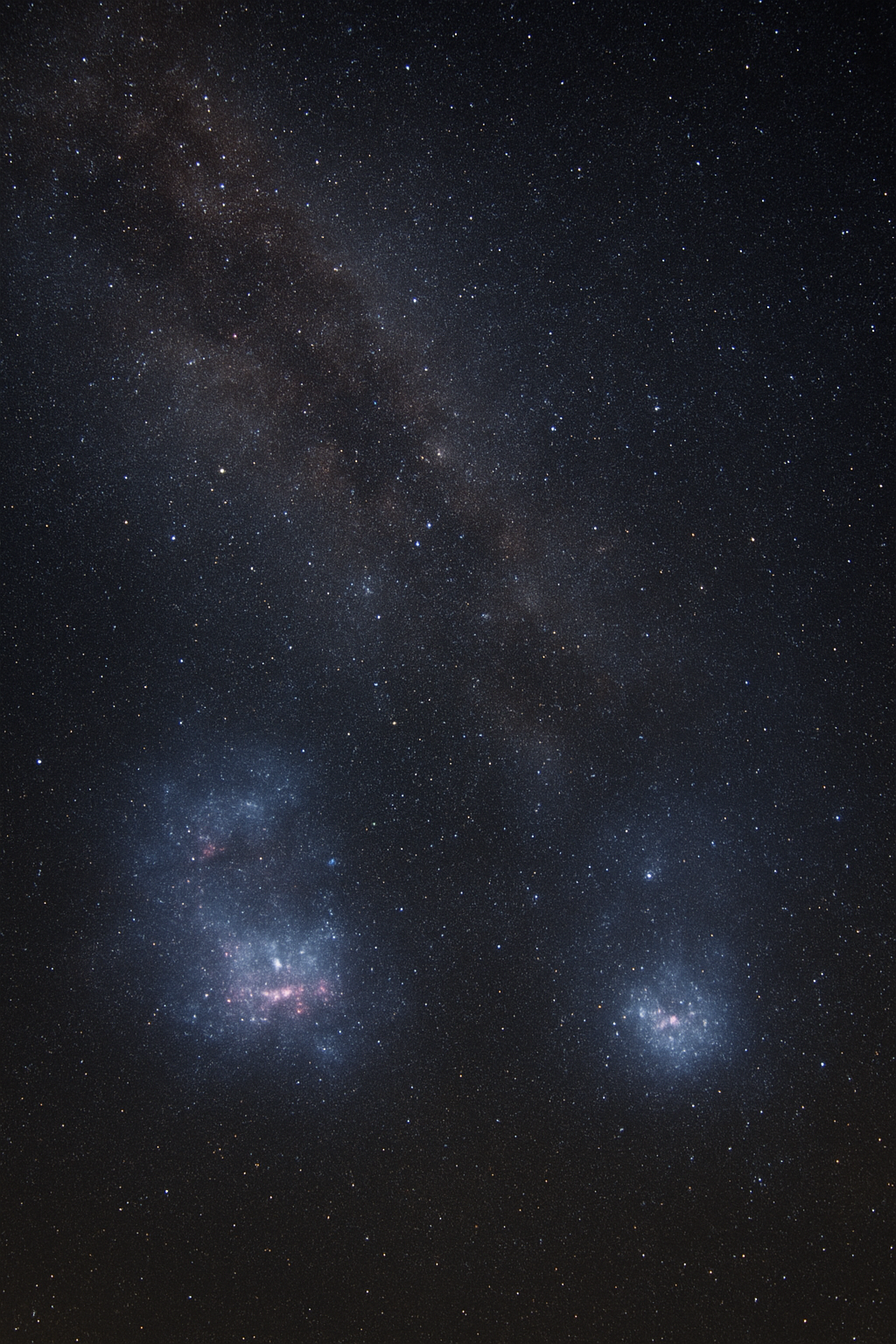
The Large and Small Magellanic Clouds (LMC and SMC) represent two spectacular irregular dwarf galaxies that hold a unique place in our cosmic neighborhood. These twin stellar companions orbit the mighty Milky Way galaxy, serving as visible reminders of the vast complexity of our local group.
Historically, these clouds have captivated humanity since prehistory. They are so prominent that they were observed by various advanced civilizations, including Polynesian navigators and medieval astronomers, lending them significant cultural weight alongside their scientific appeal. Their distinct visibility from the Southern Hemisphere makes them incredible targets for stargazers traveling to southern latitudes.
The Cosmic Dance: Orbiting the Milky Way
Traditionally, the Magellanic Clouds have been viewed as satellites in a gravitational dance around the Milky Way. They are members of the Local Group, one of the larger superstructures we inhabit. However, deep-space measurements, such as those conducted by advanced spacecraft like ESA’s Gaia, are constantly refining our understanding of their movements.
While long thought to have been orbiting steadily for billions of years, recent research suggests that stellar dynamics within the system are active and complex. For instance, newer studies indicate that the SMC is undergoing significant structural changes, potentially being pulled apart by its larger sibling or by the gravitational influence of the Milky Way itself.
What Makes Them Unique Stellar Showcases?
These dwarf galaxies appear to us as breathtaking, patchy wisps of stars, offering a window into stellar processes far grander than our own. The Large Magellanic Cloud (LMC), in particular, is famous for being an active stellar nursery. It has been the site of spectacular cosmic events, including a notable supernova outburst in 1987.
Within the LMC lies the Tarantula Nebula, a magnificent region of intense star formation. This area is renowned for producing massive, luminous stars and provides exceptional viewing opportunities for observing nebular gas clouds interacting with stellar radiation.
Observing the Clouds: A Personal Perspective
For amateur astronomers, viewing the Magellanic Clouds is an incredibly rewarding experience. Because they are most visible from the Southern Hemisphere, planning a trip to locations in that region dramatically increases your chances of witnessing this celestial beauty overhead. The grandeur of seeing these galaxies appears as diffuse patches against the backdrop of countless Milky Way stars remains truly awe-inspiring.
Understanding the Magellanic Clouds is not just about viewing distant light; it is about understanding our own galactic place within the vast tapestry of the Local Group—a constant reminder of cosmic interaction and evolution. Observing them offers a thrilling, tangible connection to deep time and powerful celestial mechanics.
- Log in to post comments