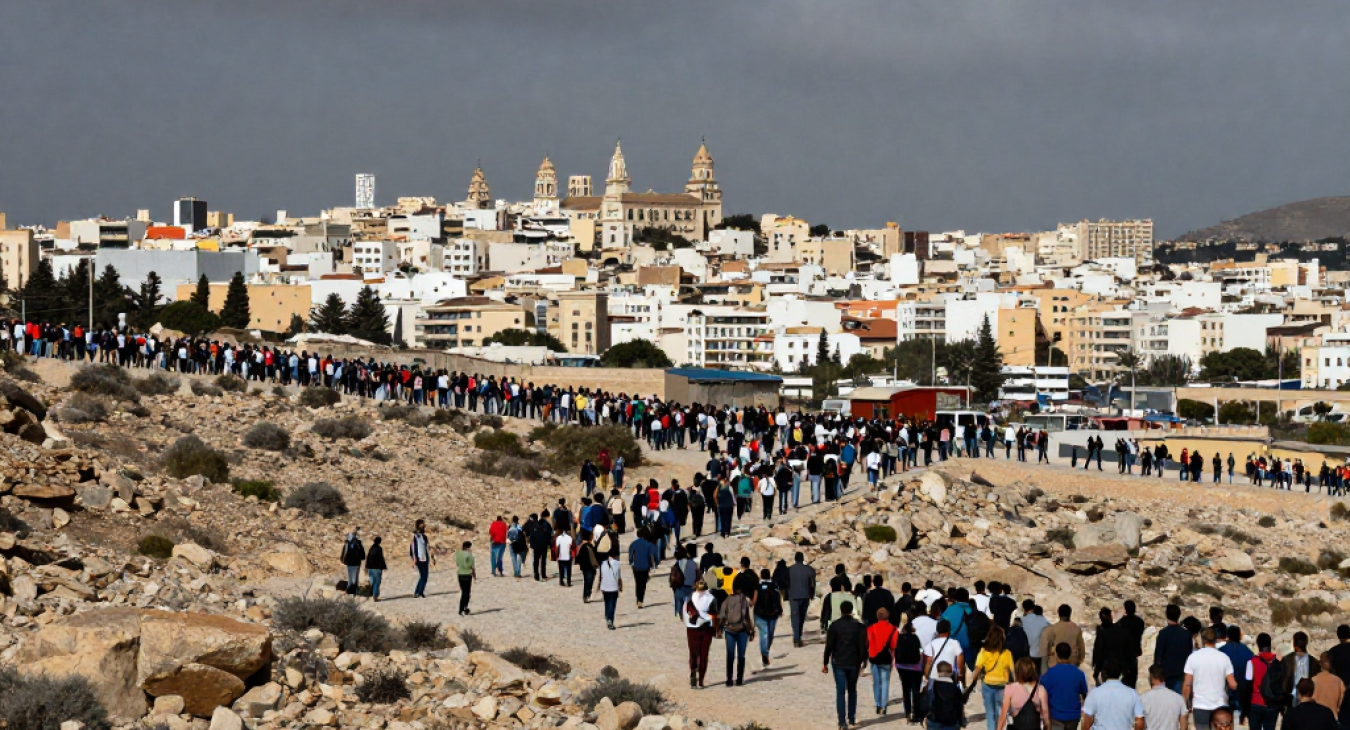
In the village of al-Mughayyir, the air carried the weight of heavy grief this week. Funerals for Omar al-Nassan, 19, and Khalil Abu Alia, 16, brought neighbors and relatives into the streets. They carried coffins draped in the colors of the Palestinian flag, moving through a landscape defined by sudden, sharp loss. These were not soldiers on a battlefield, but teenagers in their prime. Their deaths have become the latest markers in a widening pattern of violence across the West Bank, where the line between civilian friction and lethal force has grown increasingly thin.
A Dispute Over Livestock
The incident that claimed the lives of al-Nassan and Abu Alia began with a dispute over property. Local officials and eyewitnesses describe a confrontation centered on livestock. According to those in the village, Israeli settlers arrived to take sheep, a move Palestinians identified as theft. The teenagers were reportedly attempting to protect their community's assets when the situation turned deadly. This specific type of friction—disputes over grazing lands and animals—has become a recurring trigger for violence in rural areas near growing Israeli settlements.
The Israeli military (IDF) offered a different account of the afternoon. Their reports state that troops were deployed to the village to provide security for an Israeli civilian and police officers who were working to retrieve livestock. The IDF characterized the subsequent events as a "violent disturbance" involving stone-throwing. In their version, the military fired upon individuals they identified as instigators. This gap in narratives highlights the fundamental disagreement that defines much of the daily life in the West Bank: what one side calls a criminal act or a riot, the other calls a defense of rights or a pursuit of resources.
The Role of the IDF in Settler-Friction
The presence of the IDF during these encounters raises questions about the nature of security in the occupied territories. When military forces move into a Palestinian village to safeguard the movements of settlers, the role of the soldier shifts from neutral peacekeeping to active protection of settler interests. This dynamic creates a structural imbalance. In al-Mughayyir, the deployment was intended to facilitate the retrieval of animals, yet the result was the death of local youths. For Palestinians, this is not an isolated security operation; it is part of a pattern where military presence appears to prioritize the protection of settlers over the lives of the villagers.
This asymmetry is not new. As settlements expand across the West Bank, the friction between growing Israeli communities and Palestinian agricultural life intensifies. The military presence often serves as a buffer that tilts heavily in one direction. When stone-throwing occurs, the military response is frequently lethal. These "security operations" often result in fatalities among teenagers, adding new names to a growing list of casualties in a conflict that seems to have no ceiling for escalation.
The Nablus Deaths and a Wider Pattern
The violence in al-Mughayyir is not a standalone event. In Nablus, 15-year-old Youssef Shtayyeh was also killed by Israeli forces. His funeral in the village of Tell on Friday mirrored the somber atmosphere in al-Mughayyir. Shtayyeh was only fifteen. The age of these victims—15, 16, and 19—suggests that the brunt of this escalating violence is being borne by the youth. In the West Bank, being a teenager means living in a constant state of high-alert, where a routine encounter can turn into a fatal encounter in minutes.
The data suggests a spike in these incidents. It is not merely a series of random clashes but a systematic erosion of the protections that should theoretically exist for non-combatants. As the legal and military control over the West Bank tightens, the space for Palestinian civilian life shrinks. The deaths of these three boys represent a loss of potential that stretches far beyond their individual families; they represent the psychological toll on a generation growing up under the shadow of constant, lethal uncertainty.
The Cycle of Impunity
A central issue driving this cycle is the perceived lack of accountability. When settlers are involved in incidents resulting in Palestinian deaths, the subsequent legal processes are often criticized for their lack of rigor. The disparity in how violence is investigated and prosecuted creates a sense of impunity. When there are no clear consequences for those who initiate these confrontations, the threshold for violence continues to drop. The law, as applied in the West Bank, often functions differently depending on whether the actor is a settler or a Palestinian.
This legal and structural environment fuels the anger that leads to stone-throwing, which in turn leads to lethal military response. It is a feedback loop. The cycle is not just about the physical act of violence; it is about the institutional framework that allows it to repeat without resolution. For the people in al-Mughayyir and Nablus, the issue is not just about one incident of sheep or one stone; it is about the fundamental realization that their safety is not a guaranteed right under the current system of occupation.
The Social Toll of Constant Insecurity
Beyond the physical deaths, there is a deeper, more invisible cost: the psychological damage to Palestinian society. Growing up in an environment where a drive to the field or a walk through the village can end in a shooting creates a state of chronic stress. This is the lived reality for Palestinian youth. The sense of insecurity is not a temporary condition; it is the baseline of their existence. It affects how they learn, how they socialize, and how they view their own future.
The funerals held this week were more than just mourning rituals. They were assertions of presence in a territory that feels increasingly out of reach for them. As the settlements grow and the military presence intensifies, the social fabric of Palestinian villages is being strained to its breaking point. The deaths of Omar, Khalil, and Youssef are not just statistics in a news report; they are the human faces of a crisis that is becoming more permanent every day.