
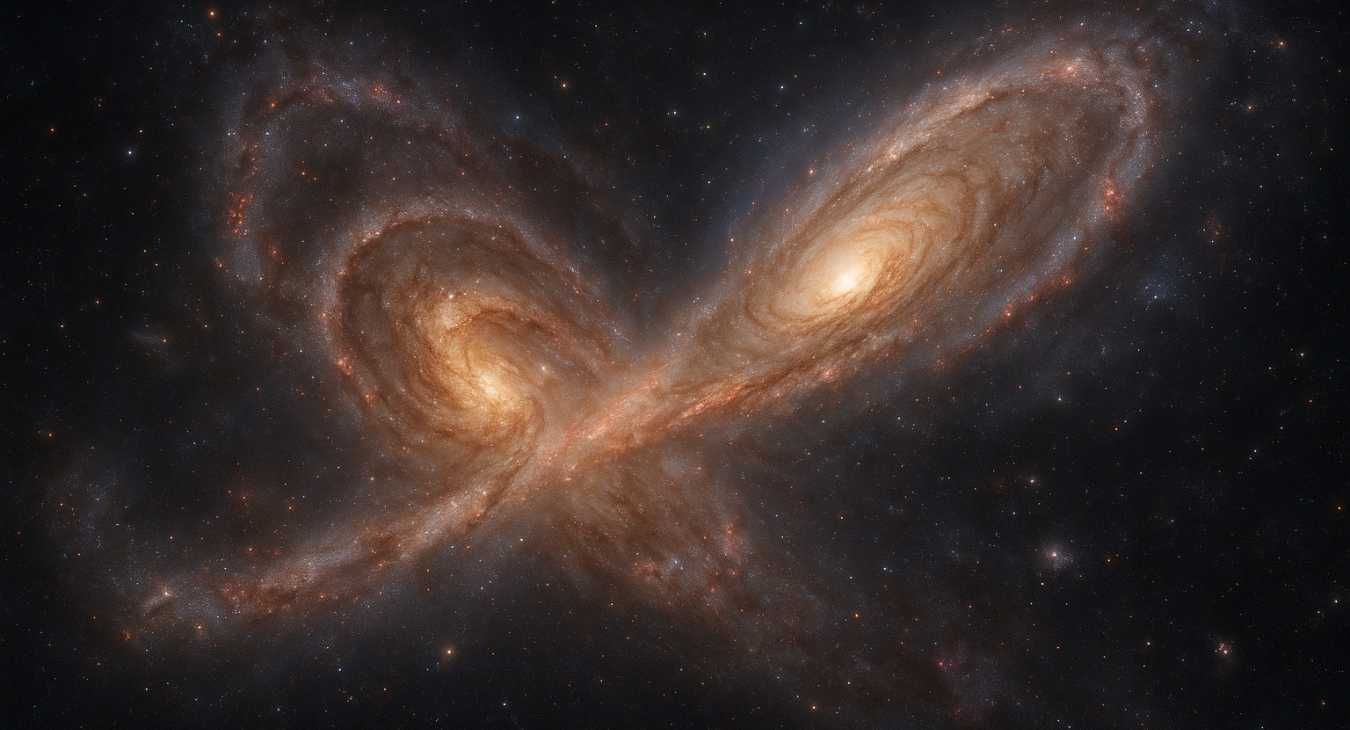
Epic photorealistic deep-space photograph of the Milky Way and Andromeda galactic merger, with vast swirls of hydrogen gas, tidal star streams, and gravitational distortions against a cosmic backdrop.

The anticipated cosmic dance between the Milky Way and the Andromeda galaxy is one of the most fascinating predictions in modern astronomy. This monumental event, predicted to occur in roughly 4.5 billion years, will mark a galactic merger that astronomers have studied since 1912.

While the term

English
Opfølgende spørgsmål
How might the specific distribution of dark matter in both galaxies influence the precise trajectory and timing of the collision?
What specific gravitational mechanisms will determine whether the merger results in a stable elliptical galaxy or a more chaotic stellar structure?
To what extent will the movement of individual star systems be affected by the merger, and what are the mathematical odds of a direct stellar collision?
How will the influx of gas and dust during the merger impact the rate of new star formation within the resulting 'Milkomeda' galaxy?
In what ways could the massive black holes at the centers of both galaxies interact or merge, and what are the potential electromagnetic consequences of such an event?



