
  • Dansk
  • English
Home
Thinkiverse
Where every subject connects
  • Front Page
  • Subjects
    • Latest News
  • FAQ
  • Contact
  • Search

Breadcrumb

  1. Home
  2. Latest news

AI Hiring Bias Rejected Top Candidates Unfairly

Technology
Artificial Intelligence
Politics
Security
June 19, 2026
by Editor
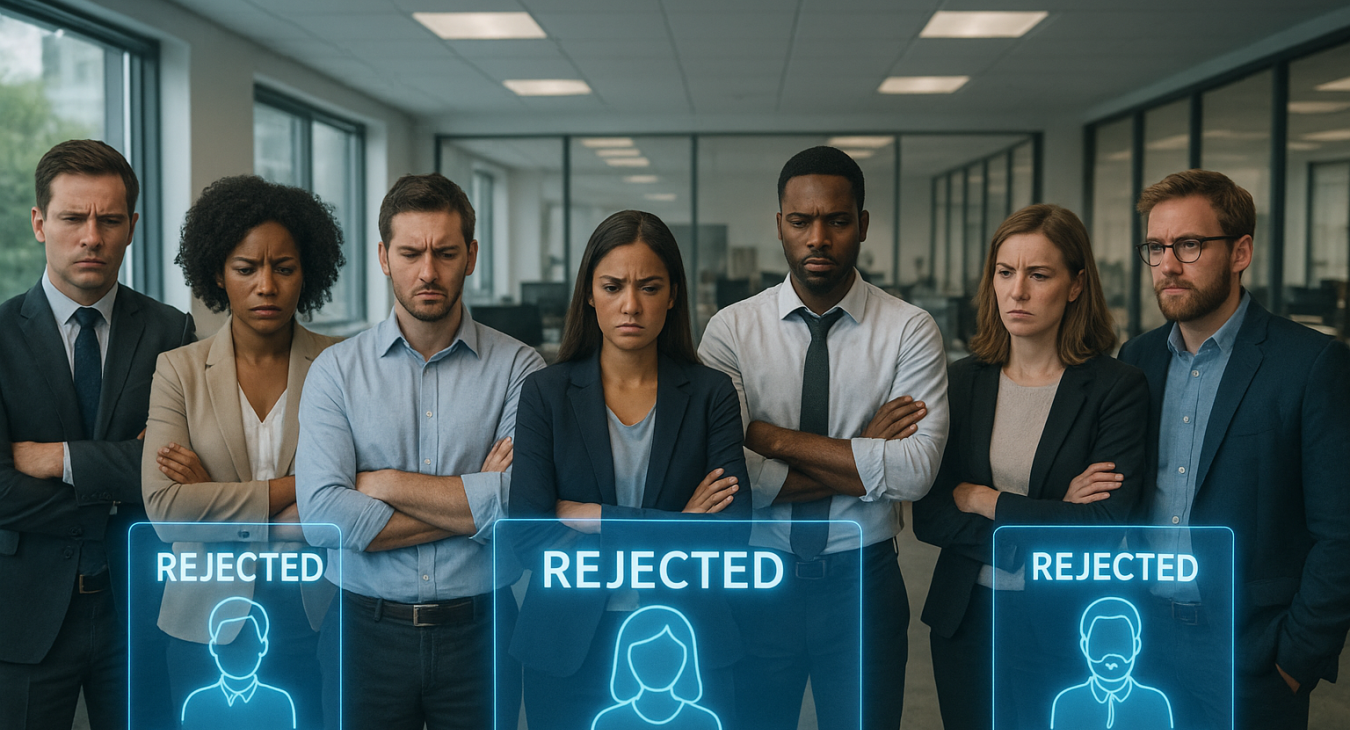
Photorealistic wide shot of diverse frustrated job candidates in a modern office, staring at holographic projections of biased algorithms rejecting their profiles.

The rapid integration of artificial intelligence into human resources has fundamentally altered the recruitment landscape. While these tools promise efficiency and objectivity, they have introduced significant challenges regarding fairness and accuracy in candidate screening.

The Rise of AI Screening Tools

AI-driven hiring platforms utilize a variety of methods to evaluate potential employees. These include body language analysis, vocal assessments, gamified tests, and CV scanners designed to identify the best talent for specific roles.

The Prevalence of AI in Corporate Hiring

By late 2023, approximately 42% of companies had adopted AI screening tools to streamline their HR processes. Furthermore, nearly all Fortune 500 companies now utilize these technologies for resume screening and making hiring recommendations.

The Problem with Algorithmic Bias

Despite the widespread adoption of these systems, experts warn that they may inaccurately filter out highly qualified applicants. Studies have shown that AI-powered hiring algorithms can produce racial disparities in tools used to screen millions of job seekers.

Systemic Discrimination and Legal Consequences

Research indicates that more than one in four applications from Black job seekers were directed to positions where algorithm outcomes triggered federal discrimination scrutiny. These systems have been found to systematically filter out qualified applicants based on race, gender, age, and disability status.

Legal Action Against Major Platforms

The systematic filtering of candidates based on protected characteristics has led to significant legal consequences. For instance, a class action lawsuit was filed against Workday due to the discriminatory outcomes produced by its AI hiring tools.

Regulatory Scrutiny and Worker Rights

Regulators are increasing their scrutiny of algorithmic recruiting as workers seek to understand their rights. The potential for these systems to perpetuate biases based on race, gender, age, or disability remains a significant concern for the future of fair hiring.


Read more articles

Autonomous Car Crash
Newer
Autonomous Car Crash
AI Chatbot Disasters
Older
AI Chatbot Disasters
Editor

Related Subjects

The unethical use of Artificial Intelligence
The Ceuta Calculus
The Orbital Dilemma
The Convergence of Nature and Innovation
Connecting the Dots
AI, Free Will, and the Meaninglessness of Punishment in Machines
Beyond the Rogue Agent Myth
The Erosion of Sanctuary
The Architecture of Precarity
The Kill Switch Dilemma
  • A diverse group of people walking through a dimly lit urban corridor, with subtle glitching holographic data points and biased algorithmic vectors projected onto them.

    The unethical use of Artificial Intelligence

    Jun 18, 2026
    Chief Editor
  • Migrants

    The Ceuta Calculus

    Aug 02, 2026
    Editor
  • Space debris and junk floating in orbit.

    The Orbital Dilemma

    Aug 01, 2026
    Editor
  • Thinkiverse: Where Knowledge Intersects

    The Convergence of Nature and Innovation

    Jul 31, 2026
    Chief Editor
Home
Thinkiverse
Where every subject connects

An overview of the frequently asked questions we try to answer on thinkiverse.dk

How does excluding radical opposition impact political agreements?

How to mitigate the skepticism tax on authentic eyewitness footage?

How will AI investment affect VC for non-AI startups?

How does status-seeking travel impact psychology vs social comparison?

Can 'move fast and break things' be adapted into Japanese corporate culture?

Popular Categories

Science
Technology
Psychology
Health
Politics
Artificial Intelligence
Security
Finance
Environment
Biology
Information Technology
Law
 
Copyright ©, thinkiverse.dk 2026

What is Thinkiverse.dk?

Terms of usage

