
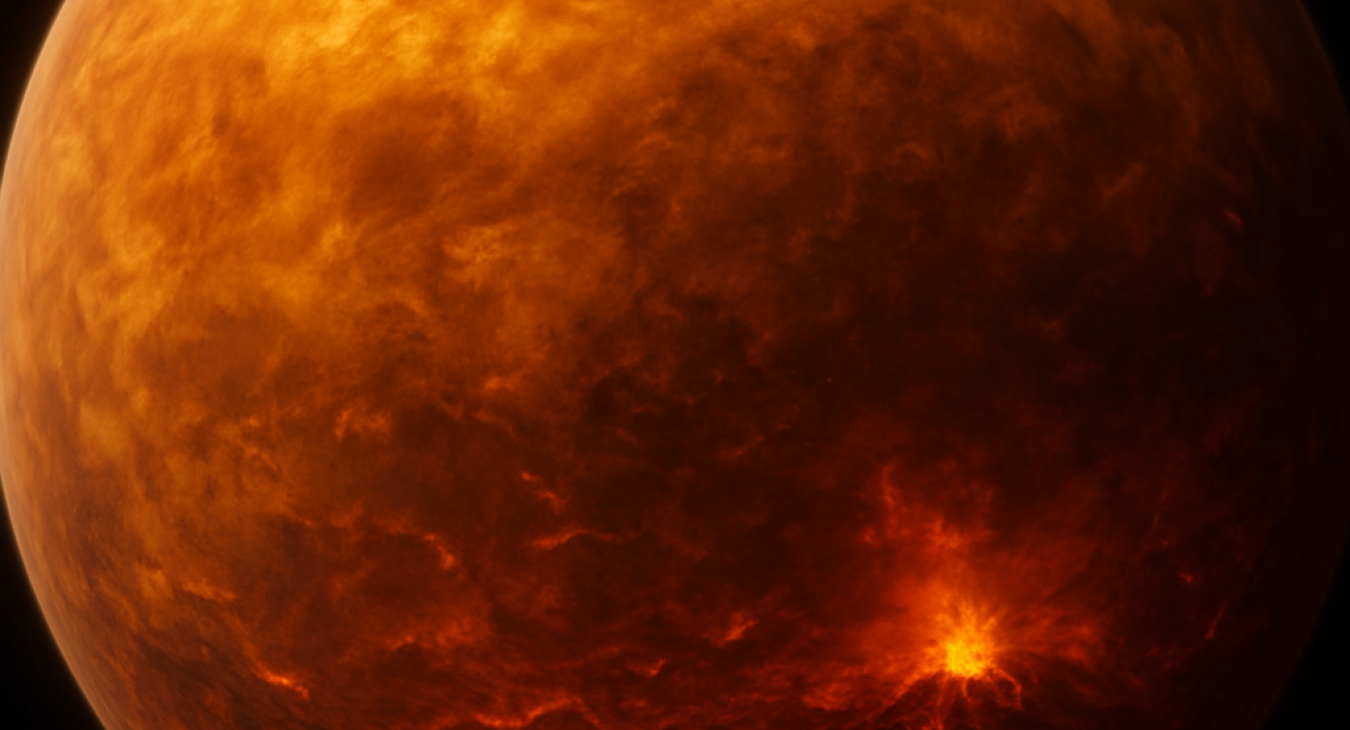
Dreaming of an exotic getaway? While destinations like Paris or Bali await, space offers a spectacle far more dramatic—and cautionary. We’re talking about Venus, often dubbed Earth's 'evil twin,' and its terrifying tale provides a sobering guide to what could happen if our planet were to succumb to a runaway greenhouse effect.
The Tropical Inferno: What is the Runaway Greenhouse Effect?
To truly appreciate Venus, one must understand its atmospheric drama. Unlike Earth’s cozy blanket of nitrogen and oxygen, Venus's atmosphere is thick, hot, and composed primarily of carbon dioxide (CO2). Over geological timescales, a process known as the runaway greenhouse effect trapped so much solar energy that the planet became an uninhabitable inferno.
This isn't just about feeling warm; it’s extreme. The surface pressure on Venus is crushing—about 90 times greater than what we experience at sea level—and its average temperature, estimated to be over 462°C (863°F), hot enough to melt lead.
A Tourist Warning: Deception in the Clouds
From a distance, Venus appears strikingly similar to Earth—a yellowish-white marble. But appearances are dangerously deceiving. The thick cloud layers raining sulfuric acid act as both an atmospheric shroud and a colossal heat trap. If we were somehow able to take a 'trip' (or more accurately, surviving space excursion) past its veil, the reality below is far grimmer than any deserted island.
Below those swirling toxic clouds lies not a liquid ocean ready for a cruise ship, but a baked and barren surface, perpetually strewn with lava-formed rock. Any signs of life as we know it are utterly obliterated by the relentless heat.
The Lesson Learned: Earth's Critical Climate Check
Why does this planetary disaster hold such appeal for space science enthusiasts? Because Venus serves as the ultimate cautionary tale regarding humanity’s relationship with climate change. It shows us a dire possibility: that if we continue to emit greenhouse gases (like CO2) faster than our planet can absorb them, Earth could follow Venus’s path.
The sheer scale of the heating and pressure buildup on Venus offers us unparalleled insight—a terrifying model built in space—for understanding climate tipping points here on Earth. Instead of booking a trip to an alien world, consider treating your education (and policy advocacy) as a journey to this cosmic warning sign. The key takeaway from Venus is clear: planetary cooling and stability require immediate global attention.
Venus doesn't offer exotic beach resorts; it offers scientific knowledge, providing humanity with the starkest possible portrait of environmental negligence.
Read more articles
- Log in to post comments



