
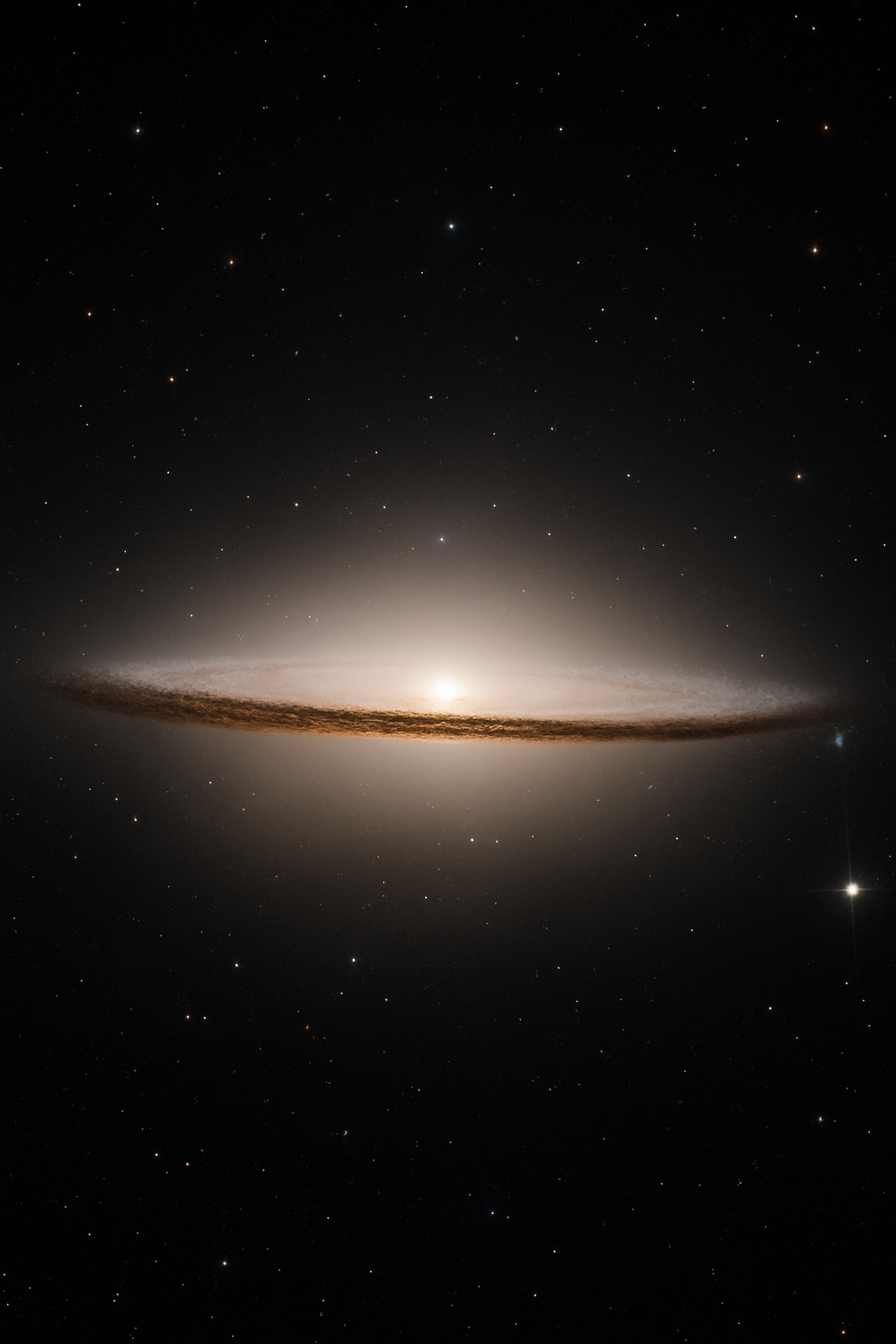
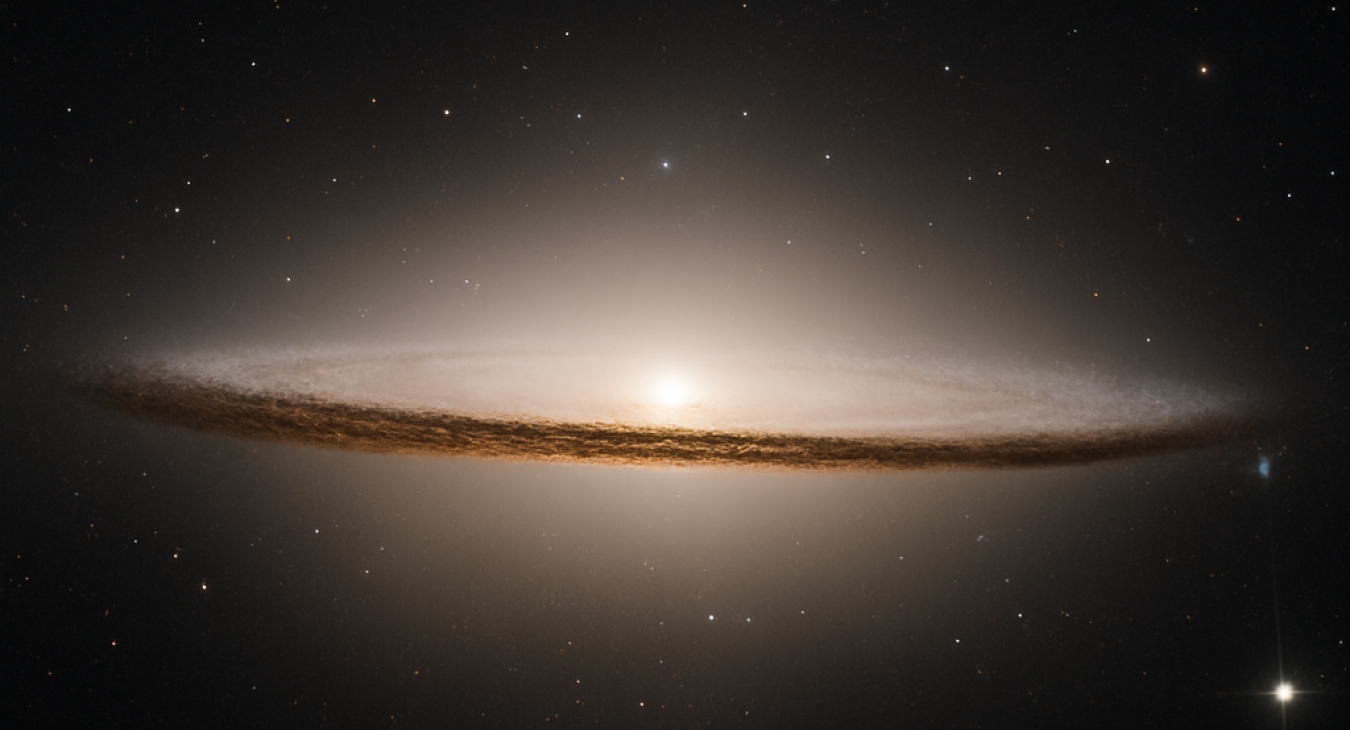
Have you ever looked up at a starry night sky and felt that profound sense of wonder? When professional astronomers gaze upon galaxies like M104, known as the Sombrero Galaxy, they experience something similar: awe. This magnificent, hat-shaped stellar structure, located roughly 30 million light-years away in the constellation Virgo, is not merely a collection of stars; it's a colossal cosmic system with secrets hidden deep within its core.
The Grand Structure and Its Stellar Wealth
Viewing the Sombrero Galaxy almost edge-on allows us to appreciate its striking resemblance to a Mexican hat—a graceful, luminous bulge encircled by a sharply defined dusty disk. The galaxy is an incredibly rich environment, boasting nearly a hundred billion stars! Astronomers have even observed that it contains approximately 2,000 globular star clusters, an astonishing number ten times greater than what our own Milky Way Galaxy holds.
From the perspective of discovery, this depth of detail is remarkable. Instruments like the Hubble Space Telescope and, more recently, the James Webb Space Telescope (JWST) have allowed us to resolve these countless structures, giving humanity a clearer picture of galactic formation over billions of years.
The Silent Giant at the Heart
While the Sombrero Galaxy is visually impressive and packed with stars, its most profound mystery lies hidden in its center. At its heart resides a supermassive black hole.
This central gravitational powerhouse is incredibly massive, estimated to weigh around 9 billion solar masses. To put that into perspective, this single entity is more than 2,000 times the mass of the giant black hole located at the center of our Milky Way! Despite its immense power, observations suggest that even this powerful core is quite calm and stable.
A Scientific Journey into Cosmic Mysteries
Learning about structures like the Sombrero's central black hole gives us a palpable sense of cosmic scale. Imagine the feeling of knowing that such immense power is operating millions of light years away! Researchers are constantly refining our understanding of these colossal objects, using advanced tools like JWST’s Mid-Infrared Instrument (MIRI) to penetrate the dense dust lanes and gather unprecedented information.
While we can't physically visit this galaxy, we get to experience its wonders through groundbreaking scientific work. For those fascinated by astronomical discovery, numerous resources are available online that detail these incredible findings from NASA and ESA collaborations, allowing you to connect with the community of celestial explorers.
The study of Sombrero Galaxy (Messier 104) serves as a powerful reminder that even when things appear stable across vast stretches of space and time, tremendous forces—like supermassive black holes—are constantly at work, shaping the evolution of galaxies into cosmic masterpieces.
- Log in to post comments