
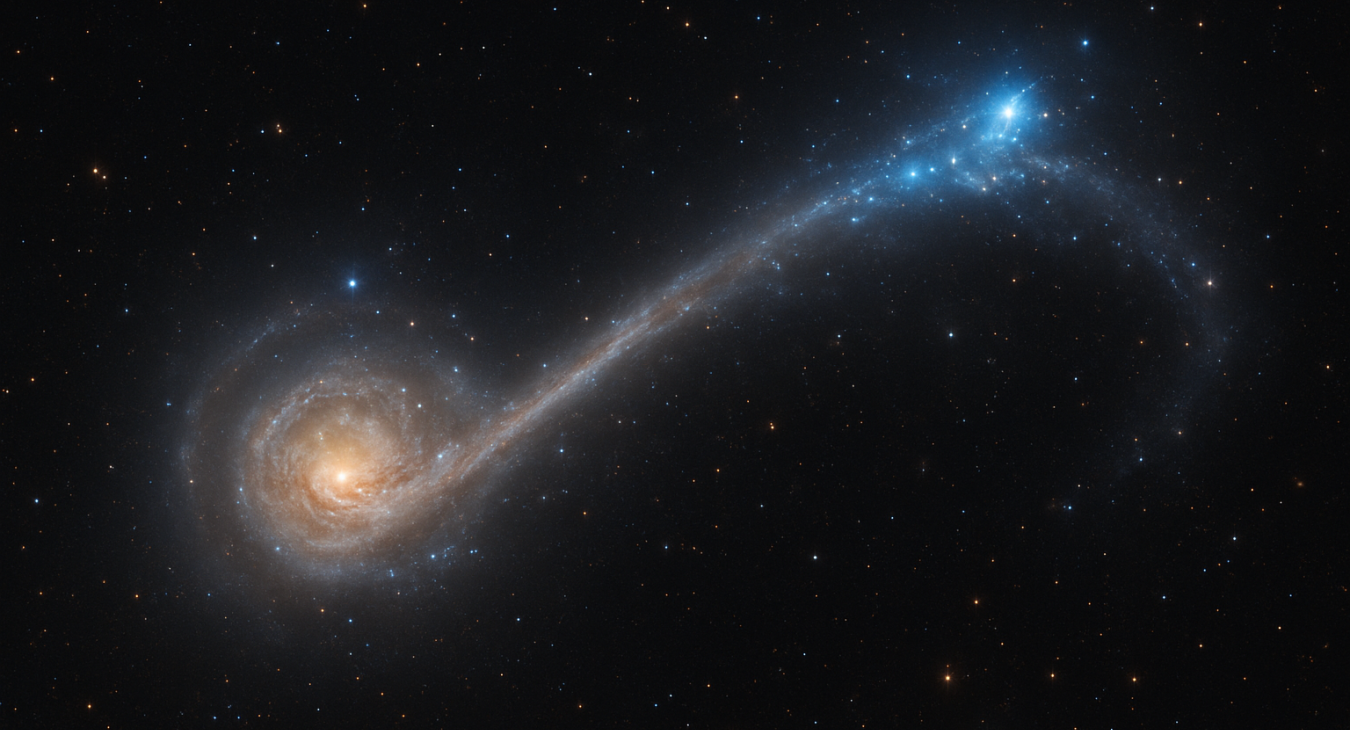
Welcome to an awe-inspiring journey into one of the most beautiful and dramatic structures in our Milky Way's cosmic neighborhood: the Tadpole Galaxy. This magnificent object, officially cataloged as Arp 188 and UGC 10214, is not just a galaxy; it is a vivid record book detailing the power of gravitational forces through galactic collisions.
Located approximately 420 million light-years from Earth in the northern constellation Draco, the Tadpole Galaxy presents a spectacular sight. Its most defining characteristic is its enormously extended tail, which stretches an astounding 280,000 to 280,000 light-years long (some estimates place it at over 275,000 light years). This stellar wake provides the basis for our understanding of galactic interactions.
The Mechanics of a Cosmic Rendezvous
The spectacular tail is not intrinsic to the galaxy's original shape; rather, it is evidence of a powerful past event. Scientists theorize that the Tadpole Galaxy underwent a close gravitational encounter with another galaxy—an intruder—at some point in its history. During this cosmic rendezvous, immense tidal forces stretched out the spiral galaxy's stars, gas, and dust, forming the spectacular tail.
Observations suggest that a more compact intruder crossed directly in front of Arp 188. The gravitational pull from this passage slung material behind the primary galaxy, creating the long, brilliant trail visible today. This process makes it one of the largest known disrupted spiral galaxies of its sort, offering unique insight into galactic merger dynamics.
Stellar Signatures and Bright Blue Wonders
The visual drama is enhanced by the star clusters inhabiting this structure. The tail region is filled with massive, bright blue star clusters. These clusters are often triggered or energized by the merger event itself. Some of these remarkable groups contain staggering numbers of stars, sometimes reaching as many as one million.
These young, luminous stars and gas clouds are key pieces of evidence astronomers use to calculate the energy and forces at play during the collision. The sheer magnitude of star formation proves that such close encounters can profoundly impact stellar life cycles.
Observing the Phenomenon
Viewing this phenomenon requires the power of sophisticated instruments, such as the Hubble Space Telescope's Advanced Camera for Surveys. Despite its immense distance, the Tadpole Galaxy is a magnificent target for astronomical observation.
While it can be spotted in 8- to 10-inch amateur telescopes under excellent viewing conditions (given its apparent size of about 3.6 by 0.8 arcminutes), studying its true structure and scale requires powerful orbital assets. This makes the Tadpole Galaxy a cornerstone subject for astrophysics research, helping us write the grand narrative of how galaxies evolve over cosmic timescales.
The ongoing study of Arp 188 provides practical details about gravitational physics and the immense power required to reshape stellar systems across vast distances in the universe. It is truly an optimistic reminder of nature's ability to create breathtaking beauty from powerful collisions.
Read more articles
- Log in to post comments



