The Foundations of Western Thought: Ancient Greek Philosophy
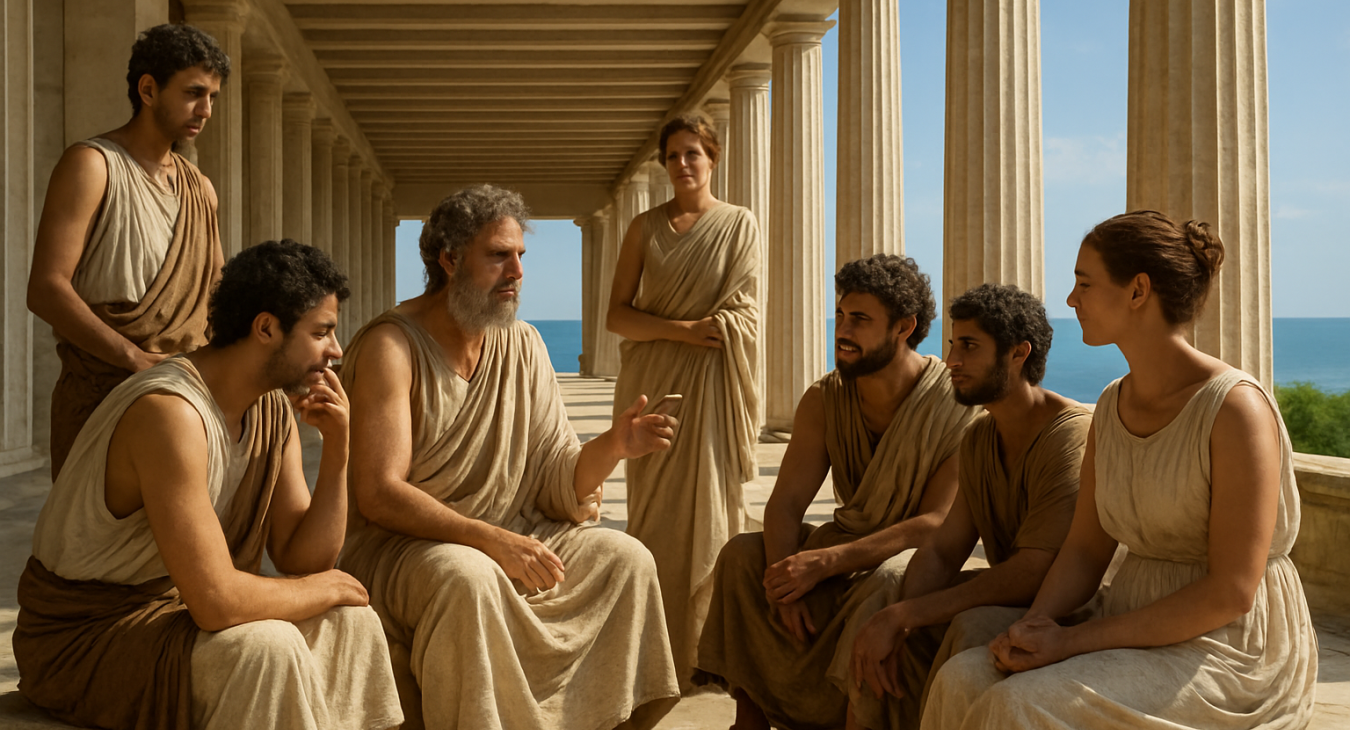
Ancient Greek philosophy serves as the bedrock of Western intellectual tradition. At the center of this movement was Socrates, a figure known for his dialectic method of inquiry. Rather than providing answers, Socrates used a series of questions to expose contradictions in his interlocutors' beliefs. This approach, often referred to as the Socratic Method, emphasizes the importance of critical questioning and the pursuit of truth through logical investigation. His primary focus remained on ethics and the nature of virtue, prompting thinkers to ask what it truly means to live a good life. Plato, the most famous student of Socrates, expanded these inquiries into a comprehensive metaphysical system. Plato proposed the Theory of Forms, which suggests that the physical world we perceive through our senses is merely a shadow of a higher, unchanging reality. In this ontological framework, the 'Forms' or 'Ideas' represent the perfect and eternal essences of all things. Through his work, particularly in 'The Republic', Plato also explored political philosophy, envisioning an ideal state governed by philosopher-kings who possess true knowledge of the Good. Aristotle, a student of Plato and a tutor to Alexander the Great, shifted the focus from abstract metaphysics to empirical observation. While Plato looked toward the heavens for truth, Aristotle looked toward the earth. He laid the groundwork for formal logic through his development of the syllogism, a form of reasoning where a conclusion is drawn from two given premises. Aristotle's work covered a vast array of subjects, including biology, physics, and ethics. His concept of 'Eudaimonia', often translated as flourishing or happiness, became a central pillar of virtue ethics, suggesting that human excellence is achieved through the cultivation of habits and the application of reason.The Rationalist Revolution and the Birth of Modernity
Moving into the early modern period, the focus of philosophy shifted toward epistemology, or the study of the nature and limits of human knowledge. René Descartes, often hailed as the father of modern philosophy, sought to establish a foundation for certain knowledge that could withstand any doubt. Using a process of methodic doubt, he stripped away all uncertain beliefs until he reached a single, undeniable truth: 'Cogito, ergo sum' (I think, therefore I am). This principle established the thinking subject as the starting point for all subsequent knowledge, marking a decisive turn toward rationalism. In contrast to the rationalism of Descartes, the school of empiricism argued that all knowledge originates from sensory experience. Philosophers like John Locke proposed that the human mind at birth is a 'tabula rasa', or a blank slate. According to this view, we acquire ideas and concepts only through our interactions with the external world via sight, sound, touch, taste, and smell. This perspective was crucial in the development of the scientific method and modern psychological theories regarding perception and cognition.The Enlightenment and the Synthesis of Reason and Experience
Immanuel Kant emerged as one of the most influential figures in the history of philosophy by attempting to bridge the gap between rationalism and empiricism. Kant proposed a transcendental idealism, arguing that while our knowledge begins with experience, the mind is not a passive recipient of information. Instead, the human mind actively structures experience through innate categories such as space, time, and causality. His work, particularly 'Critique of Pure Reason', sought to determine the boundaries of what human reason could achieve and what remained beyond our grasp. Kant also revolutionized ethics with his concept of the Categorical Imperative. Unlike hypothetical imperatives, which dictate actions based on desires, the Categorical Imperative acts as a universal moral law. It commands that one should act only according to that maxim whereby they can at the same time will that it should become a universal law. This deontological approach emphasizes duty and the inherent worth of rational beings, asserting that individuals should always be treated as ends in themselves and never merely as means to an end.Existentialism and the Search for Meaning
As the 19th and 20th centuries progressed, philosophy turned inward to address the human condition, often in response to the perceived loss of traditional religious certainty. Friedrich Nietzsche challenged the established moralities of his time, famously declaring that 'God is dead'. This was not a celebration of atheism but rather an observation that the traditional foundations of morality and value had collapsed in the wake of scientific and secular advancements. Nietzsche proposed the concept of the 'Übermensch', or Overman, as a figure who creates their own values and finds meaning in a world without inherent purpose. This theme of individual existence and the burden of freedom was furthered by Jean-Paul Sartre and the movement of existentialism. Sartre argued that 'existence precedes essence', meaning that humans are not born with a predetermined purpose or nature. Instead, we find ourselves thrown into a world without a blueprint, and we are entirely responsible for defining who we are through our choices. This radical freedom, while empowering, also brings 'angst' or 'anguish', as the weight of our responsibility for ourselves and for humanity is immense.Utilitarianism and Social Ethics
While existentialists focused on individual meaning, other thinkers turned their attention to the mechanics of social organization and collective morality. John Stuart Mill was a leading figure in the development of Utilitarianism, a consequentialist ethical theory. Building on the ideas of Jeremy Bentham, Mill argued that the most moral action is the one that produces the 'greatest happiness for the greatest number'. Mill refined this theory by distinguishing between higher and lower pleasures. He argued that intellectual and moral pleasures are qualitatively superior to mere physical sensations. This distinction helped move utilitarianism away from a simple calculus of pleasure and toward a more sophisticated understanding of human well-being. The principles of utilitarianism continue to influence modern debates in economics, public policy, and bioethics, providing a framework for evaluating the outcomes of social decisions through the lens of collective welfare.Conclusion: The Ongoing Dialogue
The history of philosophy is not a closed book but a continuous dialogue across centuries. From the Socratic inquiry of ancient Athens to the existentialist struggles of the modern era, each thinker has added a new layer to our understanding of existence, knowledge, and morality. By studying these core ideas, we gain more than just historical knowledge; we acquire the intellectual tools necessary to navigate the complexities of the modern world and to participate in the enduring human quest for truth.Read more articles
Newer
Older