
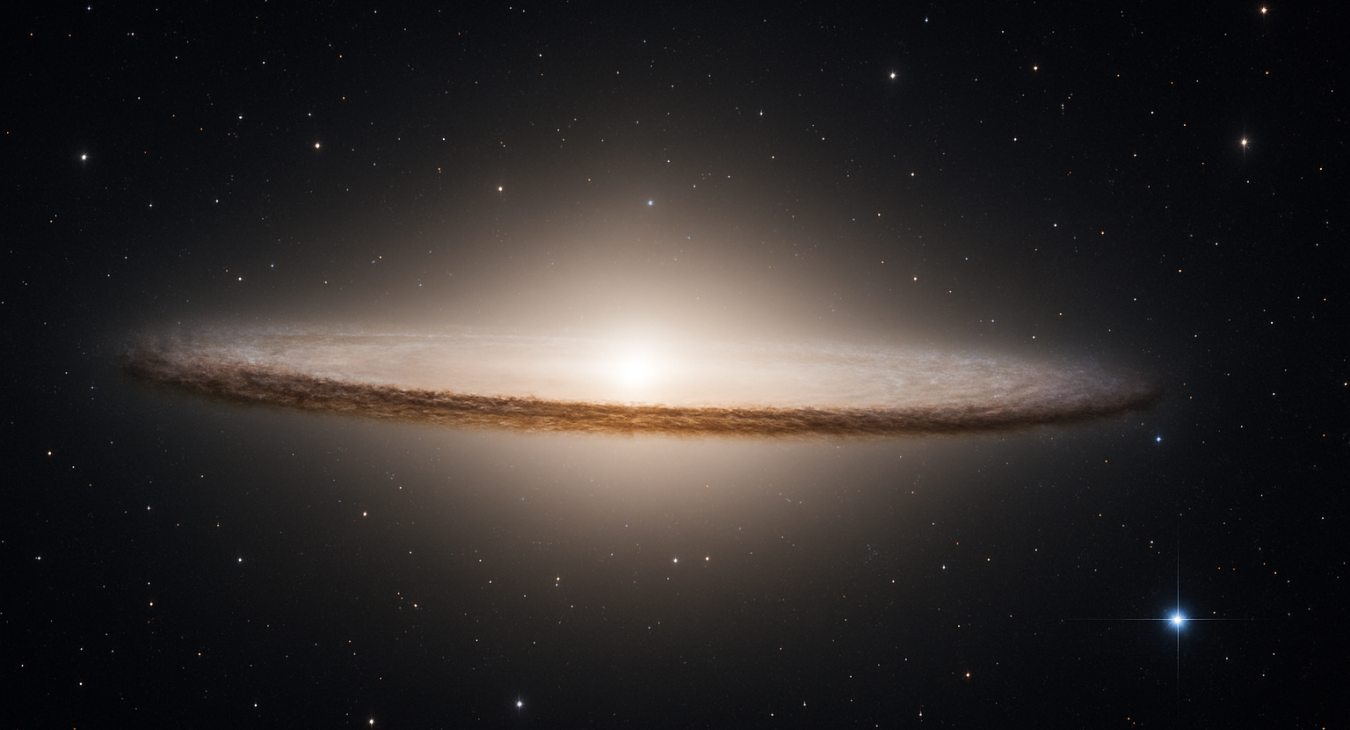
Ever gazed at the night sky and wondered about cosmic structures that defy imagination? The Sombrero Galaxy, officially known as Messier 104 (M104) or NGC 4594, is one such celestial marvel. Nicknamed for its striking resemblance to a wide-brimmed hat due to the dark dust ring surrounding its bright central core of stars, it is truly a 'cosmic masterpiece.'
A Stellar View from Earth's Orbit
This incredible galaxy is situated in the constellation borders of Virgo and Corvus. It belongs to the Virgo II Group, part of the vast Virgo Supercluster. From our perspective here on Earth, it can be spotted with a modest telescope, as it is located at a significant distance: approximately 9.55 megaparsecs (31.1 million light-years) from the Milky Way galaxy.
Unveiling the Structure and Scale
The Sombrero Galaxy is truly colossal, boasting an impressive size that makes it slightly larger than our own Milky Way. It features a stunning arrangement: a bright nucleus and unusually large central stellar bulge are encompassed by a prominent, dark dust lane in its outer disk. This distinctive pattern is what gives the galaxy its famous 'cosmic hat' shape.
Scientists estimate that M104 contains an immense population of stars; some estimates suggest it holds over 800 billion suns in total mass! Its sheer magnitude makes studying it invaluable for understanding galactic formation and stellar evolution.
Deep Scientific Mysteries
The focus of astronomical research on the Sombrero Galaxy reveals mysteries within its heart. Hubble observations have provided evidence that the galaxy harbors a supermassive black hole at its core. This black hole is estimated to be incredibly massive, potentially as large as a billion suns—one of the heftiest known cosmic structures.
Furthermore, the dust ring itself is scientifically rich, containing heavy elements and harboring countless stars, providing key data points for astronomers who study stellar populations.
Observing This Galactic Treasure
M104 remains a popular target both for amateur observers and professional astronomical research. Its intricate details, including its extended halo and faint stellar streams, capture the imagination of science enthusiasts worldwide. For those interested in viewing this galactic wonder, state-of-the-art instruments, such as the Department of Energy-fabricated Dark Energy Camera mounted on the U.S. National Science Foundation Víctor M. Blanco 4-meter Telescope at Cerro Tololo Inter-American Observatory in Chile, have captured exquisite images that showcase its breathtaking beauty.
Studying galaxies like this deepens our personal connection to the cosmos, reminding us of the vast and continuous narrative of cosmic creation.
Read more articles
- Log in to post comments



